


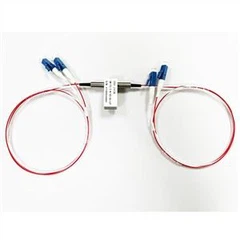
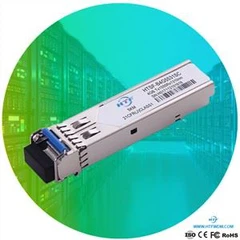


Effect
DWDM uses the bandwidth and low loss characteristics of single-mode fiber, uses multiple wavelengths as carriers, and allows each carrier channel to transmit in the fiber at the same time.
The DWDM is separated for analysis:
Dense means that the wavelength separation between the wavelength channels is dense in the range of 0.8-1.2nm, and coarse in the range of 10-20nm, so dense wavelength division multiplexer and coarse wavelength division multiplexer come from this.
Wavelength division can be analyzed as wavelength passing through the carrier, that is to say, after inputting different wavelength through the passive device of DWDM, the light of different wavelength is output as the carrier.
Multiplexing refers to that after the wavelength passes through the passive component of DWDM, each different light can be transmitted on the same single-mode fiber, so that the single-mode fiber can be fully reused.
By separating and analyzing the above words, we can simply summarize the functions of DWDM as the functions of separation wavelength (division wave) and combination wavelength (combination wave).
advantage
DWDM is a kind of laser technology used to improve the bandwidth of the existing optical fiber backbone network. More specifically, it multiplexes the close spectral spacing of a single optical fiber carrier in a specified optical fiber to achieve the purpose of transmitting multiple signals with a single optical fiber. In this way, under the given information transmission capacity, the total number of optical fibers needed can be reduced. DWDM dense wavelength division multiplexer can provide large capacity and diversified broadband services, which can enable network operators to increase the transmission bandwidth to 16, 32, 64 or even 128 times under the effective cost. At present, DWDM multiplexer / demultiplexer can provide 16 / 20 wave or 32 / 40 wave single fiber transmission capacity, up to 160 wave, with flexible expansion ability.