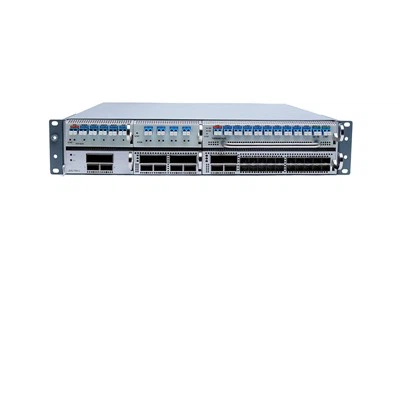

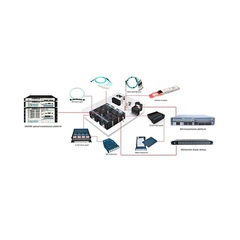




In order to meet the network requirements of 5G for larger bandwidth, higher speed, lower delay and different scenarios, the network architecture of 5G has undergone great changes, mainly reflected in the splitting of functions of BBU (baseband processing unit).
Compared with 4G, 5G wireless access network is more complex in structure. The 4G access network is mainly composed of EPC (core network), BBU and RRU (radio frequency remote unit). In 5G, considering the advantages of cloud-based base station deployment and centralized control, the original 4G BBU is divided into two logical units, CU (centralized unit) and DU (distributed unit). At the same time, with the application of multi-antenna technology in 5G, part of physical layer processing functions of BBU have to be put on RRU, so 5G will combine the remaining physical layer functions of RRU and BBU of the original 4G and the antenna to form AAU (active antenna processing unit).
The change of 5G network structure leads to the increase of middle transmission in 5G transmission, forming three parts: fronthaul, middlehaul and backhaul, which have different requirements for 5G communication optical module.
In 5G prequels, the typical 5G wireless bandwidth is 100M~1G, and the peak is 20G. The antenna port may be 64 or 128, and the granularity of the 5G prequel network is 25Gbps. From this, it can be seen that the rate requirement of future 5G prequels for optical modules will take 25Gbps as the mainstream.
In 5G transmission, n*25G technology and DWDM ring network structure will be adopted, and the transmission distance can be up to 10~40km, which means that in 5G transmission will be dominated by the optical module with a rate of 100Gbps.
In 5G return transmission, if OTN is networked, n*100G technology will be adopted. If there is no OTN network, 200G/400G optical module technology will be adopted, and whatever technology is adopted, the 5G return transmission will be dominated by 100G optical module or higher speed optical module.
Development trend forecast of 25G optical communication products
With the change of 5G network architecture, the CU and DU structure separated from the BBU structure will bring a substantial increase in the demand for optical modules. Meanwhile, with the increase in the number of 5G macro stations, the demand for optical modules is expected to reach more than 1.8 times of that in the 4G era.
According to the data, in 2017, the market demand for wireless prequel increased, and the demand for 25G/100G optical modules rose rapidly. In 2019, with the trial and commercial use of 5G, the demand for 25G/100G optical modules will increase rapidly, while the demand for 40G optical modules will decline, among which the demand for 25G optical modules will reach 1 million. In 2021, 5G networks of major operators will enter the peak period of large-scale construction, and 25G/100G optical modules will usher in explosive growth, among which the demand for 25G optical modules will exceed 2 million. In the future, data center, wireless network, access network and transmission network will form a demand resultant force for 25G optical module, and the industrial chain application of 25G optical module will gradually replace 10G optical module to become the mainstream, meeting the new breaking point.
With the trial operation of 5G in 2019 and the official commercial use of 5G in 2020, 25G optical communication products will usher in a new peak of development. As the world's leading Internet solution provider, HTF has been paying close attention to the development of 5G. In order to provide strong support for 5G, HTF will continue to develop and innovate 25G series optical communication products, and strive to provide the best solution for global 5G suppliers.