





Classification of video optical modules
1. The video optical module can be divided into 850nm, 1310nm, 1490nm, 1550nm, etc.
2. The video optical module can be divided into single receive, double receive, single transmit, double transmit and receive.
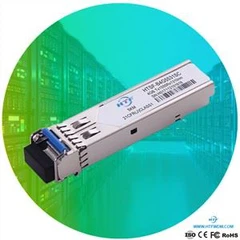
3. The video optical module is divided into 3G video optical modules, 6G video optical modules and 12G video optical modules according to the transmission rate. Details are as follows:
(1) The 3G video optical module is generally an SFP package, which conforms to the standards of smpte-424m, smpte-292m, smpte-259m SDI, and 3Gbps HD-SDI and DVB-ASI (en50083-9). When 3G video optical module is used with multi-mode fiber, its working wavelength is 850nm with a maximum transmission distance of 300m. When used with single-mode fiber, its working wavelength is generally 1310nm/1550nm with a maximum transmission distance of 40km.
(2) The 6G video optical module conforms to the standards of SMPTE 259M, SMPTE 344M, SMPTE 292M, SMPTE 424M and SMPTE 2081, and is often used in 4K/HDTV/SDTV service interface, suitable for cameras, video and security monitoring.
(3) 12G video optical module is generally SFP+ package type, which conforms to the standards of SMPTE 259M, SMPTE 344M, SMPTE 292M, SMPTE 424M, ST2081 and st-2082, and is often used in UHDTV/HDTV/SDTV service interface and compatible optical interface of SMPTE st-297-2006, ST2081 and st-2082.
Foreground of video optical module
The combination of 5G with low time delay, high bandwidth capacity and ultra-HD video will affect every aspect of our lives, including home TV, entertainment, remote education and remote monitoring, which all need HD video transmission. When 5G is ubiquitous, you'll be able to see the world at home in VR.