


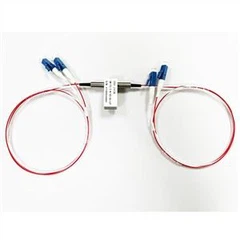
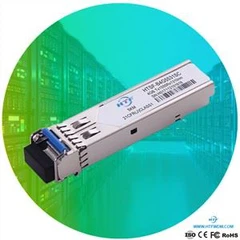


At present, the main schemes used in 5G fronthaul are passive wave division and fiber direct connection. Passive wave component has the advantages of occupying less fiber core and rapid deployment, etc. With the further reduction of the price, it has become the main technical scheme for 5G fronthaul at the present stage. Optical fiber direct connection is divided into two fiber bidirectional and single fiber bidirectional (BIDI) according to the different optical modules used by wireless equipment. Which is better, single fiber bidirectional or double fiber bidirectional? What are the advantages and disadvantages compared to the passive component? Will there be a place for it in 5G?
Technical principle of single fiber bidirectional
Single-fiber bidirectional refers to transmitting and sending optical signals in both directions simultaneously in a single fiber. The optical modules used in the wireless equipment are all integrated optical transceiver modules. The dual-fiber bidirectional optical module has two connection ports with optical fiber, while the single-fiber bidirectional optical module has only one connection port with optical fiber.
Single fiber bidirectional is mainly realized by WDM. The light module on the side of BBU sends a laser with wavelength 1 through the 45° spectrometer and then couples into the optical fiber. At the AAU end, the light signal with wavelength 1 is received after being reflected by the 45° spectrometer; And vice versa.
The transceiver of single-fiber bidirectional optical module adopts different wavelengths, and the working wavelength of 5G fronthaul optical module is generally 1270nm/1330nm or 1270nm/1310nm. That is to say, the single fiber bidirectional light module contains two models, must be used in pairs. For the communication system without explicit A and B ends (such as PTN and other ring network systems), it is easy to make mistakes in use, while for the communication system with explicit A and B ends, as long as the optical module with A certain wavelength is specified for A or B ends.
Differences between single - core bidirectional and other prequel schemes
1. Construction of optical cable lines
(1) Fiber direct connection scheme
Single fiber bidirectional occupying the core number although only double fiber bidirectional half, but in most cases, the main fiber cable is the same length. For example, 1 CRAN machine room reception of the number of large stations is generally 5 to 15, if the number of BBU is the maximum of 40, then the use of single/double core scheme, the occupancy of the trunk fiber core number is 120/240 core, in the same route are only laid a trunk optical cable.
As a result of single fiber bidirectional occupation of the fiber core is less, the original metrocell access to the fiber core can meet the demand for access, so, distribution cable (trunk optical intersection ~ Metrocell) construction volume is usually only about half of the two fiber bidirectional scheme.
(2) Passive wave division scheme
At present, the passive wave component of 5G fronthaul mainly adopts 6-fold 1 and 12-fold 1 system, which consumes very little fiber core. However, due to the requirement of the front cable network to share ODN with broadband service, if there are no optical fiber resources between CRAN machine room and the main optical fiber, the main optical fiber still needs to be built.
And the remaining fiber core resources of the original access to the station can mostly meet the needs of use, as long as the construction of part of the optical fiber from the trunk to metrocell distribution cable.
2. Project investment
Single-fiber bidirectional and double-fiber bidirectional optical modules are only slightly different in transmitting/receiving devices, and there is little difference in component cost. But because the market demand of single fiber bidirectional light module is small, the price is slightly higher about 15%.
The passive wave parting system contains a combination/parting device, and the optical modules with a wavelength of 1351nm and 1371nm have a large dispersion cost, so APD detection devices with a higher price are needed, and the component cost will be higher. Due to the same market size, the unit price of the current single-fiber bidirectional system is about 10% higher than that of the passive wave subsystem.
Since dual-fiber bidirectional optical modules are included in the current procurement of Wireless equipment in China Mobile, the original optical modules need to be replaced when adopting passive wave minutes, so the difference between the costs of passive wave minutes after considering the replacement cost of optical modules is not so obvious.
3. Maintenance and management
Since the wavelength used by the single-fiber bidirectional module does not incur a large dispersion cost, the transmission index is no different from that of the dual-fiber bidirectional module. In use, it only needs to specify one wavelength for AAU terminal and another wavelength for BBU terminal, which will not bring any inconvenience to operation and maintenance.
However, the passive wave subsystem has the following disadvantages:
(1) The wavelength of 1351nm and 1371nm has a large dispersion cost, which will lead to limited transmission distance;
(2) The use wavelength of BBU and AAU end light modules should be planned with the cooperation of the port of the wave splitter;
(3) It is necessary to install a combination/split-wave device in the optical fiber link, with many active connections and fault points in the link;
(4) There are many optical modules, which make maintenance and management inconvenient.
Conclusions and Recommendations
Compared with bidirectional, single-fiber bidirectional has obvious advantages in cost and will not increase the inconvenience in maintenance and management. Single-fiber bidirectional scheme should be adopted for direct fiber connection.
At present, the procurement of wireless equipment in China Mobile has included dual-fiber bidirectional light modules, and the original light modules cannot be well utilized when adopting passive wave front separation scheme. In this way, it is better to adopt single-fiber bidirectional light modules uniformly in the equipment procurement, which is not only cheaper in cost, but also conducive to maintenance and management.
If the optical module of wireless equipment is purchased separately, the cost of passive wave component is the lowest. Due to the limitation of dispersion cost, the low cost passive wave component scheme is not suitable for the long distance transmission, so it is suggested to adopt the single fiber bidirectional scheme when the fronthaul distance is long.