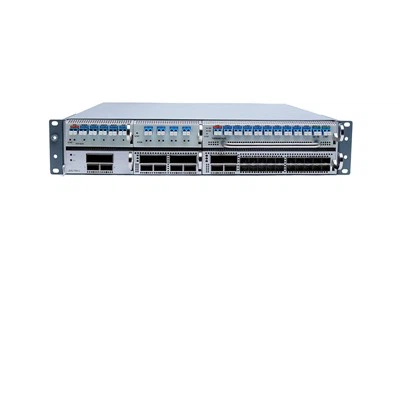





Data center has become the engine of modern life; the increasing network information is transmitted and stored at high speed through the data center. Most of the connections within the data center are short, ranging from a few meters to a few hundred meters. In these short range and high speed data communication, multimode fiber and optical module with VCSEL as the core device are widely used. Compared with the single-mode transmission scheme, the multi-mode scheme adopts a low-cost and low-power laser to realize fast and efficient coupling between the fiber and the laser. Multi-mode fiber can achieve higher transmission rate or longer transmission distance than copper cable and lower cost than single-mode fiber system. At present, the internal connection rate of data center is already 100Gbit/s, and 400Gbit/s is expected soon. The industry has been developing new multimode fiber to improve its performance, including WDM in single fiber. Long wave multimode fiber supports longer transmission distance. In addition, in order to support high-density, miniaturized connection, improve the space utilization rate, heat dissipation efficiency and cable management efficiency of data center, multi-mode fiber with bending resistance has been developed and deployed rapidly. In this paper, the development trend of multimode fiber supporting high speed optical module is discussed by combining the technical principle of multimode fiber and the evolution of optical module technology.
1. Multi-mode optical fiber technology and application scenarios
The development of cloud computing has promoted the development of super-large data centers, thus generating different development trends from traditional enterprise data centers. Whether domestic or international, the evolution of server port rate by the users of VLCC with cloud computing services is obviously faster than that of traditional enterprise data centers. Traditional enterprises will steadily use multi-mode OM4 fiber, and more than 90% of the system link length is less than 100m.
Users of super-large data centers are more likely to choose single-mode fiber, and 70% of the system link length is over 100m. The development of super-large data centers has improved the utilization rate of single-mode fiber, but multi-mode fiber still has its unique advantages. These advantages include the availability of lower cost optical modules, lower power consumption, and transmission distances that cover most of the links in the data center, so solutions based on multimode fiber and multimode optical modules remain attractive to customers.
2. Bandwidth of 850 nm multimode fiber
Different from the single-mode system, the transmission distance and rate of the multi-mode system are limited by the bandwidth of the multi-mode fiber. The mode bandwidth of multimode fiber needs to be increased to support the longer distance of high-speed system.
With the development of fiber design and manufacturing, the bandwidth of multimode fiber has been greatly improved. The 62.5μm multimode fiber has a high numerical aperture and a large fiber core, which can couple light-emitting diode (LED) light source into the fiber and support data transmission of 2km at a rate of 10 Mbit/s or even 100 Mbit/s. With the development of Ethernet standard and low-cost 850nm VCSEL, multi-mode fiber with core diameter of 50 micron fiber is more popular in the market. The fiber has lower mode dispersion and higher bandwidth, and the VCSEL's spot size and numerical aperture are smaller than LED's, allowing the laser to be easily coupled into a 50 micron fiber. By optimizing the optical fiber manufacturing process and adopting advanced refractive index control technology, the 50μm multimode optical fiber developed from OM2(500 MHz*Km) to OM3(2 000 MHz*Km), and now has developed to OM4(4 700 MHz*Km).
For a multi-mode system using 850 nm VCSEL, further increasing the bandwidth of OM4 multi-mode fiber cannot make the optical module transmit further distance, because the system bandwidth depends on the combination of the effective mode bandwidth of the fiber and the dispersion (which is related to the spectral line width of the VCSEL laser and the wavelength of the fiber). If the system bandwidth needs to be increased, in addition to the effective mode bandwidth of the fiber, the dispersion value needs to be optimized. This can be achieved by using differential mode delay (DMD) multimode fiber to compensate for partial dispersion, or by using a narrower line width of 850nm VCSEL or working in a longer wave region with lower dispersion.
The maximum relative refractive index of the fiber core also affects the maximum bandwidth. When the core drops from 1% to 0.75%, the bandwidth doubles. However, reducing the fiber core will increase the bending loss, so it is necessary to optimize the fiber structure design to improve its bending performance.
3. Bending-insensitive multimode fiber
In data center applications, bending-insensitive multimode fiber is more and more widely used, which can optimize the design of optical fiber, hardware and equipment to save more space, have better cooling efficiency and more convenient connection and cable management. The core is graded index, and the cladding has a low index groove. The groove reduces the optical power in the cladding and can prevent the leakage of optical signals, thus improving the bending performance of the fiber. Fiber design optimizes the core and groove size of the fiber, and achieves a balance between bending performance and compatibility with standard multimode fiber. Through reasonable design of fiber core and groove, multimode fiber can achieve OM4 level of high bandwidth and low bending loss. The macro bending loss of bending-insensitive multimode fiber is more than 10 times lower than that of conventional standard multimode fiber.