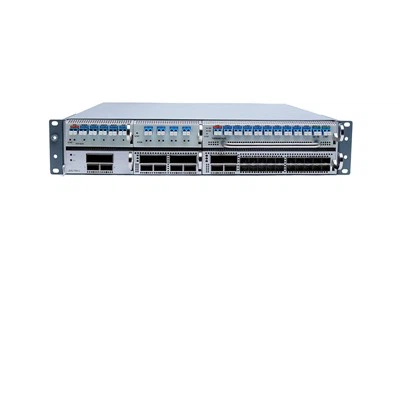





DWDM (dense wavelength division multiplexing) can combine a group of optical wavelengths and transmit them with a single fiber. This is a laser technology used to increase bandwidth in the existing fiber backbone network. More specifically, the technique is to multiplex the close spectral spacing of individual fiber carriers in a specified fiber to take advantage of achievable transmission performance (e.g., minimum dispersion or attenuation). In this way, under the given information transmission capacity, the total number of optical fibers needed can be reduced.
One of the key advantages of DWDM is that its protocol and transmission speed are not related. DWDM based network can use IP protocol, ATM, SONET / SDH, Ethernet protocol to transmit data, and the data flow is between 100MB / s and 2.5gb/s. In this way, DWDM based networks can transmit different types of data traffic at different speeds on a laser channel. From the perspective of quality of service (QoS), DWDM based network can quickly respond to customers' bandwidth requirements and protocol changes in a low-cost way.
Dense wavelength division multiplexing (DWDM) is a kind of wavelength division multiplexing (WDM) technology to expand the transmission capacity of the existing optical network. It can multiplex multiple optical carrier signals to a single optical fiber for transmission, and can save a lot of optical fiber resources in long-distance transmission applications. At present, there are mainly two kinds of DWDM systems: passive DWDM system and active DWDM system.
Passive DWDM System
Passive DWDM system does not use active devices such as fiber amplifier and dispersion compensator. The transmission distance of this system is limited by the transmission power of optical module, but it has the advantage of high channel capacity. It is mainly used in man and high-speed transmission lines with high channel capacity.

Active DWDM System
Active DWDM is a kind of system including repeater, which is used for optical electrical optical (OEO) conversion. In addition, the system is also equipped with multiple erbium-doped fiber amplifiers (EDFAs) to ensure that the receiving end can receive high-quality optical signals. However, the number of EDFAs is limited by fiber type, number of wavelength channels, transmission rate, signal-to-noise ratio (OSNR) and other factors.

The link length of active DWDM system is not only related to the number of fiber amplifiers and signal-to-noise ratio (OSNR), but also affected by the dispersion of optical signal. Therefore, in the design of active DWDM system, the dispersion of optical signal should be taken into account. If necessary, a dispersion compensator (DCM) can be added to the active DWDM system. It should be noted that the dispersion compensator (DCM) will increase the insertion loss of the optical fiber link and affect the transmission distance of the active DWDM system.
Advantages and disadvantages of passive DWDM System
Cost saving: compared with active DWDM backbone network with fiber amplifier and dispersion compensator, passive DWDM can construct high-speed transmission line with high channel capacity at lower cost.
Simple to use: passive DWDM is a plug and play system, which is simple and convenient to use.
However, the passive DWDM system has some shortcomings in the following aspects.
Scalability: the number of wavelength channels in passive DWDM system is limited. If you want to expand the network, you must use more passive DWDM devices, which will increase the difficulty of system management.
Advantages and disadvantages of active DWDM System
Active DWDM system supports more wavelength channels, so the bandwidth is larger and the utilization of optical fiber is higher. In addition, the active DWDM system is easier to manage, users can adjust the channel wavelength online without shutting down the system, and the expansion of the active DWDM system is easier.
Compared with passive DWDM system, active DWDM system has longer transmission distance and higher deployment cost. In addition, active DWDM system also uses fiber amplifier, dispersion compensator and other equipment, which is more complex than passive DWDM system.
Passive DWDM system and active DWDM system have their own advantages. We should deploy appropriate DWDM system according to specific application requirements. No matter which system is deployed, DWDM multiplexer / demultiplexer is essential.
HTF's products quality is guaranteed, and the accessories are imported.
Contact: support@htfuture.com
Skype :sales5_ 1909,WeChat :16635025029