


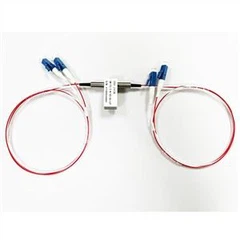
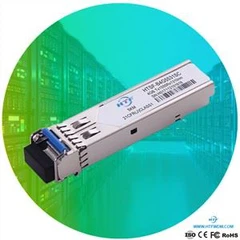


The optical transceivers at both ends of the active optical cable provide photoelectric conversion and optical transmission functions to improve the transmission speed and transmission distance of the optical cable without weakening the compatibility with the standard electrical interface.
According to the material of the cable, it can be divided into:
High speed cable, including active high-speed cable and passive high-speed cable
Active optical cable (AOC)
What is AOC?
Active optical cable (AOC) is translated as active optical cable. Active cable = two optical transceivers + cable jumper.AOC is composed of integrated optoelectronic devices, which is used for data center, high-performance computer, large capacity memory and other devices for high-speed and high-reliability interconnection. It usually meets the industrial standard electrical interface, and uses the advantages of optical cable for data transmission through internal electric optical electrical conversion.
What is a DAC?
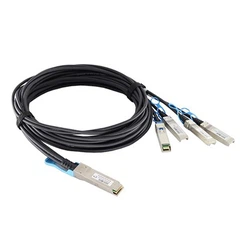
Direct attach cable, referred to as DAC, is generally translated as high-speed cable, direct connection cable or direct copper cable. This kind of cable is not replaceable port, and the module head and copper cable cannot be separated.High speed cable DAC is made up of silver plated conductor and foam insulated core wire, which adopts wire pair shielding and total shielding.

Application:
AOC is composed of integrated optoelectronic devices, which is used for data center, high-performance computer, high-capacity memory and other devices for high-speed and high-reliability interconnection. It usually meets the industrial standard electrical interface, and uses the advantages of optical cable for data transmission through internal electric optical electrical conversion.
DAC is generally used in the switch of data center computer room
DAC can be active or passive, while AOC is active.
In the data center, copper cables are generally used to connect servers and storage area networks. The most commonly used is direct attach copper cable (DAC), and the passive copper cable is especially used. Because of its low price and high transmission speed, passive copper cable has become the best solution to realize short distance transmission.
Who will be the winner in data and communications?
AOC fiber optic cable has longer transmission distance and reduces electromagnetic interference. However, in data center, it is often the wisest to use DAC copper cable, because DAC provides significant advantages in capital expenditure, operating expenses, performance and reliability.
Advantages of DAC:
1. Distance: the DAC can be extended to several meters, and its length depends on the network speed, which is usually more than enough for the interconnection within the data center. Whether connected between servers in a single rack or switches in a cluster, DAC provides this function: reliable and affordable transmission with the highest available bandwidth.
2. Cost: DAC provides the benefits of significant savings. Generally speaking, the cost of passive copper cable is two to five times cheaper than the same length of optical cable. In addition, because DAC does not consume electricity and its thermal design has low cooling requirements, it can greatly save the operating expenses of data center. If you use DAC copper instead of AOC, you can save hundreds of kilowatts of electricity.
3. Reliability and speed: one of the greatest advantages of DAC is reliability, which is measured by mean time between failure (MTBF). The MTBF of passive copper cables is about 500 million hours - usually an order of magnitude higher than the industry standard for fiber optic cables. DAC offers a big benefit for enterprise data centers, where reliable data transmission is critical: avoiding downtime.
4. Higher data transmission rate: the current high-speed cable can support the data transmission rate from 4gbps to 10Gbps, which is higher than that supported by traditional copper cable.
5. Strong interchangeability: with the development of copper technology, high-speed cable and optical fiber transceiver can be interchanged and hot swapped.
6. Low cost: copper cable is cheaper than optical fiber, and using high-speed cable will reduce wiring cost.
7. Good heat dissipation: high speed cable is made of copper core, which has good heat dissipation effect.
8. High performance: it is suitable for short distance wiring in data center, with wide application range and strong integration scheme ability.
9. Energy saving and environmental protection: the internal material of high-speed cable is copper core, and the natural heat dissipation effect of copper cable is good, which is energy-saving and environmental protection.
10. Low power consumption: low power consumption of high-speed cable. Because the passive cable does not need power supply, the power consumption is almost zero; the power consumption of active cable is generally about 440mw.
11. Low cost: the price of copper cable is much lower than that of optical fiber, so the use of high-speed cable can greatly reduce the wiring cost of the entire data center.
Disadvantages of DAC :
1. Short transmission distance, large weight, large volume, difficult to manage.
2. It is easy to be affected by electromagnetic interference, such as bad response and degradation.

The design of AOC is lightweight, just like DAC, which is widely used in storage area network, data center and high performance computing connection. AOC uses optical signals and cannot conduct current, so it is immune to electromagnetic interference.
Advantages of AOC active fiber optic cable:
1. Larger bandwidth: no equipment upgrade is required, and the throughput is up to 40Gbps.
2. Lightweight: much lighter than high-speed cable.
3. Low electromagnetic interference: optical fiber is a kind of dielectric, so it is not easy to be affected by electromagnetic interference.
4. Bending radius: the cable of AOC is very thin and the bending radius is very large. If there is not enough wiring space in the data center, AOC is the best solution.
5. Airflow and cooling: due to the fine design of AOC cable, the switch will have more ventilation space and be easy to cool the system.
Disadvantages: compared with high-speed cable, the cost of active optical cable is higher.

Performance comparison between DAC and AOC
High speed cable (DAC) can be divided into active high-speed cable (ACC) and passive high-speed cable (PCC). The difference between them is that the former has one more driver chip. DAC is composed of silver plated copper conductor and foam insulation core wire. Its main application scenarios are interconnection within 5m / 10m. The "optical module" on DAC is not a real optical module. It has no components and can only transmit electrical signals. Therefore, the high-speed cable is cheaper than other ordinary optical devices.
AOC is mainly composed of two optical transceivers and an optical cable jumper. The transceivers at both ends of the optical cable provide photoelectric conversion function. Compared with DAC, AOC (active optical cables) active optical cable has stronger anti electromagnetic interference ability, and has many advantages such as high transmission rate, long distance, low time delay and low energy consumption. In the range of 300m in medium and short distance scenarios, users of data center can freely customize the length according to the actual situation, while DAC is only limited to application scenarios within 10m.
In the data center scenario, how to choose between AOC and DAC?
A server and the access switch (TOR) above constitute the basic unit of the data center. Generally speaking, the distance between the access switch and the server network card (NIC) is less than 5 m. in this ultra short distance scenario, DAC has better cost, power consumption and heat dissipation performance than active optical fiber AOC, so we choose DAC as the most appropriate one. In special scenarios, according to customer requirements, 100g qsfp28 to 4-way sfp28 DAC direct connection can be adopted.
The transmission distance from tor to edge core is generally less than 100m. At this point, the line integration is getting higher. AOC is easy to simplify the management of cables because of its light weight and small wire diameter. Data centers are very strict in the requirements of signal transmission. AOC is stronger than DAC in signal integrity and optical coupling design, which greatly ensures the reduction of error code in signal processing. In addition, because the high frequency EMI signal is processed in the pluggable module, the EMI immunity of active optical cable is higher than that of DAC. There is no doubt that AOC is the first choice for our medium and short distance switch interconnection scenarios.
According to different requirements and application scenarios, we have different best choices. At present, when the requirement of data center is not very high, DAC scheme is adopted for interconnection between servers and switches within 5m / 10m, and AOC connection scheme is adopted between switches.
If you need anything, you can contact HTF Zoey.
contact:support@htfuture.com
Skype:sales5_ 1909,WeChat:16635025029