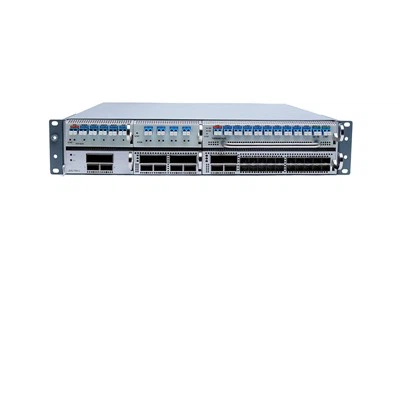



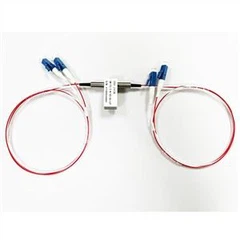


OADM
OADM is often a device found in WDM systems for multiplexing and routing different channels of fiber into or out of a single-mode fiber (SMF). It is created to optically add/drop one or multiple CWDM/DWDM channels into a few fibers, providing the power to add or drop a single wavelength or multi-wavelengths from a fully multiplexed optical signal. This permits intermediate locations between remote sites gain access to the regular, point-to-point fiber segment linking them. Wavelengths not dropped pass-through the OADM and carry on towards the remote site. Additional selected wavelengths may be added or dropped by successive OADMs if required.
Optical Amplifiers
Optical amplifiers boost the amplitude or add gain to optical signals passing on a fiber by directly stimulating the photons of the signal with extra energy. They are “in-fiber” devices. Optical amplifiers amplify optical signals across a broad range of wavelengths, which is very important for DWDM system application.
Transponders (Wavelengths Converters)
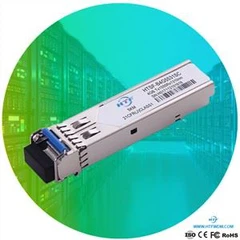
Transponders convert optical signals from one incoming wavelength to another outgoing wavelength suitable for DWDM applications. Transponders are optical-electrical-optical (O-E-O) wavelength converters. A transponder performs an O-E-O operation to convert wavelengths of light. Within the DWDM system, a transponder converts the client optical signal back to an electrical signal (O-E) and then performs either 2R (reamplify, reshape) or 3R (reamplify, reshape and retime) functions.