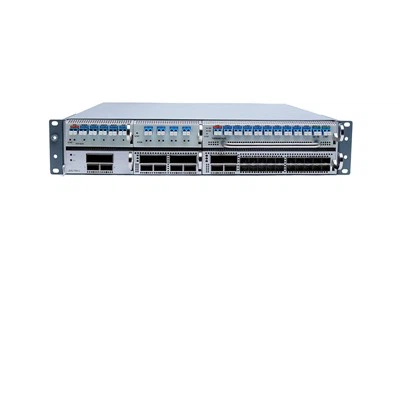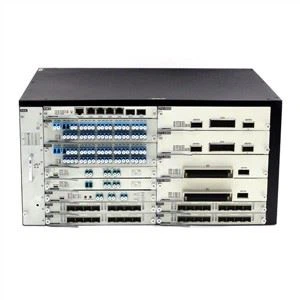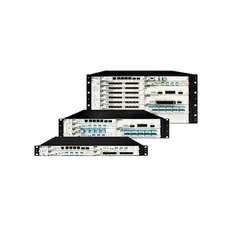
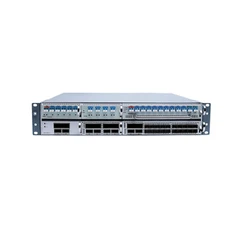

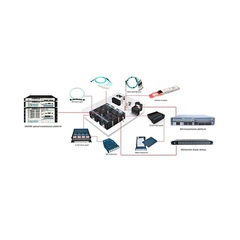




Digital transformation in all fields of the social economy has been further accelerated, bringing parallel development of the entire ICT industry and the digital economy, and driving and causing profound changes in the industry. With the influx of a large number of innovative enterprises in vertical industries, traditional industries and operation models and business models are being continuously reconstructed, including: finance, government affairs, medical care, education, industry and other fields. Faced with increasing demands for high-quality and differentiated business connections, PeOTN technologies gradually began to be widely used.
From the perspective of transmission pipeline, L0, L1 and L2 have their own characteristics:
• L0 and L1 layers provide rigid "hard" pipelines represented by wavelength and sub channel ODUk, with large bandwidth and low latency as their main advantages.
• L2 layer is able to provide flexible "soft" pipelines, whose bandwidth is exactly matched to the service and varies with the traffic flow. Flexibility and on-demand are its main advantages.
By integrating the advantages of SDH/MSTP/MPLS-TP for small particle services, a L0+L1+L2 transport network scheme was formed, and PeOTN, a multi-service transport platform, was built to create a multi-energy integrated carrying capacity of a network. In 2009, ITU-T extended THE OTN's delivery capability to support diverse services and formally incorporated PeOTN into the standards.
In recent years, the global operators with special line of enterprise market, the domestic three big operators are actively developing OTN enterprise private network construction, the provincial company also vigorously investment, it has been more than 30 provinces has launched a OTN high quality private network operators, and released the high value based on PeOTN line products, to promote the optical transmission network from the basic resources network to "business bearing network".
At the same time, the OTN network is also in continuous innovation and development in terms of openness and decoupling, and has achieved good results.
In November 2018, Beijing Unicom officially launched a "Smart Link" Smart line, which is a PEOTN-based SD-OTNN intelligent control platform and runs through the whole process service of the line.
In October 2019, China Mobile completed the decoupling between the forwarding and control of OTN CPE on THE SOTN (SDN OTN) government and enterprise private network. In terms of forwarding decoupling, local network OTN CPE and trunk equipment different manufacturers communicate through IrDI interface, and control information transmission is realized. In terms of control, OTN CPE and SDN controller are decoupled to achieve mobile self-development or third-party controller control OF OTN CPE.
In May 2020, Shanghai Unicom completed the integrated upgrade of "SDH + PeOTN". By loading SD-OTN in the OSS system, it realized the unified control of SDH and PeOTN across domains and networks, and supported the fast opening of end-to-end services and flexible online bandwidth adjustment.