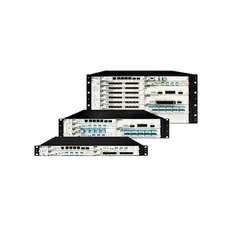
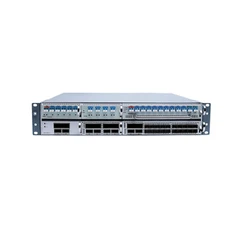

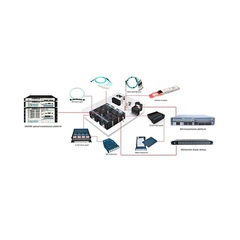


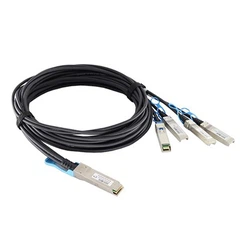
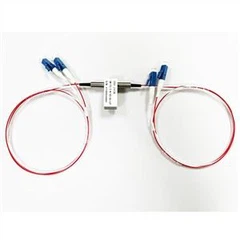
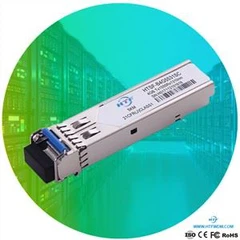


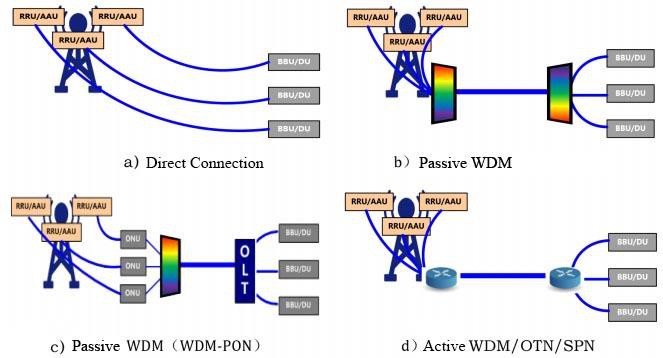
Typical application scenarios of 5G fronthaul are shown in the Figure, including direct fiber connection, passive WDM, and active WDM / optical transport network ( OTN ) / slicing packet network (SPN).
Direct fiber connection scenarios generally use 25 Gb/s gray light modules, which support two types of dual-fiber and single-fiber two-way, mainly including two transmission distances of 300m and 10km.
Passive WDM scenarios mainly include point-to-point passive WDM and WDM-PON, etc., using a pair or one fiber to achieve the connection between multiple AAUs and DUs, typically requiring 10Gb/s or 25Gb/s color optical modules.
In active WDM / OTN scenarios, 10Gb/s or 25Gb/s short-range gray-light modules are generally required between AAU / DU to WDM / OTN / SPN equipment, and N × 10/25/50Gb/s is required between WDM / OTN / SPN equipment. / 100Gb/s double-speed bi-directional or single-fiber bi-directional optical module at the same rate.
Typical requirements for optical modules in 5G fronthaul application scenarios are as follows:
(1) Meet the industrial temperature range and high reliability requirements: Considering the AAU full outdoor application environment, the front-end optical module needs to meet the industrial temperature range of -40°C to + 85°C, and dustproof requirements.
(2) Low cost: The total demand for 5G optical modules is expected to exceed 4G . In particular, front-end optical modules may have tens of millions of demands. Low cost is one of the major demands of the industry for optical modules.
In 5G, the backhaul covers the metro access layer, convergence layer and core layer. The required optical modules are not significantly different from those used in existing transmission networks and data centers .
The access layer will mainly use 25Gb/s, 50Gb/s, 100Gb/s and other gray light or colored light modules,
the convergence layer and above will mostly use DWDM colored light modules with 100Gb/s, 200Gb/s, 400Gb/s and other speeds.
What data rates optical module mainly use in the fronthaul?
25Gb/s and 100Gb/s, and supports a typical transmission distance of hundreds of meters to 20km. The specific technical status is shown in the following picture.

*1: Adopt 10Gb/s industrial grade FP or DFB laser
*2: The center values of CWDM working wavelengths are 1271nm, 1291mm, 1311nm and 1331nm respectively
*3: According to the link budget, optical amplifier and dispersion compensator can be configured;
*4: DWDM working wavelength meets ITU-tg694.1 wavelength definition
*5: The center values of four working wavelengths of 4wdm10 are 1271mm, 1291mm, 1311nm and 1331nm respectively
What data rates optical module mainly use in the 5G backhaul?
Mainly include 25Gb/s, 50Gb/s, 100Gb/s, 200Gb/s, 400Gb/s and other speeds.
Typical transmission distances range from several kilometers to hundreds of kilometers, supporting CPRI, eCPRI, Ethernet, OTN and other interface protocols, as well as NRZ, PAM4, DMT and other modulation formats, the specific technical status is shown in the following picture.