




With the rapid development of optical network communication, passive optical cables or cable systems based on copper wires are stretched, and they have gradually been unable to meet the needs of users and data transmission. So Active Optical Cable (AOC) was born in this environment.
What exactly is an active optical cable? What are the areas of application and what are the advantages?
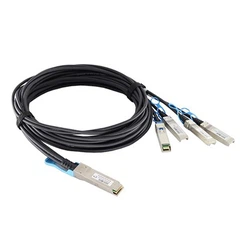
Active Optical Cables (AOC for short) are optical fiber cables equipped with optical transceivers at both ends.
As the name implies, active optical cables need external energy sources in the communication process to convert electrical signals into optical signals, or a communication cable that converts optical signals into electrical signals. The optical transceivers at both ends of the optical cable provide photoelectric conversion and optical transmission functions. The main components are divided into two parts: optical path and circuit.
Among them: the optical path part includes a lens and FA for converting the angle of the optical path; the circuit part includes a PCB board, a substrate, a VCSEL chip, a VCSEL driver chip, a PD chip, and a TIA chip.
What is the principle of active optical cable AOC?
At one end of the active optical cable, the data is input to the electrical signal, and the electrical signal is converted into an optical signal of a specific wavelength by the photoelectric conversion device. The optical signal is modulated and coupled and then input into the transmission cable. After the optical signal reaches the other end, the photoelectric detection device The optical signal is detected, amplified and processed, and then the corresponding electrical signal is output. The reverse transmission principle is the same.
What are the advantages of active optical cables?
Compared to high-speed cables:
1 lower transmission power on the system link;
2 The volume is about half that of copper cables, and the weight is only a quarter of that of high-speed cables;
3 In the computer room wiring system, the air flow is better and the heat dissipation is stronger;
4 The bending radius of optical cable is smaller than that of copper cable;
5 The transmission distance is longer, which can reach 100 to 300 meters;
6 The bit error rate of the product transmission performance is also better, and the BER can reach 10^-15.
Compared with optical modules:
1 The optical interface of the active optical cable is not exposed, that is, there is no problem of cleaning and contamination of the optical interface;
2 Higher system stability and reliability;
3 Make the network system more convenient to manage and maintain;
4 Greatly reduce operation and maintenance costs and improve efficiency.
What fields are active optical cables used in?
1 In laboratories and teaching centers, active optical cables connect multiple machines to the host, which not only ensures high-speed data transmission, but also ensures network security.
2 Both data centers and cloud computing systems require higher bandwidth and lower power. 10G SFP+ and 40G QSFP+ in active optical cables can well connect devices (switches, routers) with high-speed optical communication ports.
3 Digital signage is also a good place for active optical cables to show their talents, which can support 1080p resolution in an outdoor HDMI environment. Not only that, active optical cables are also useful in large-scale outdoor interactive games.