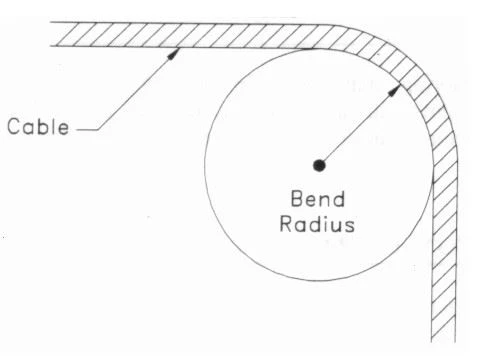





When you install fiber optic jumper cables, you should not bend them beyond their bend radius, for light may "leak out" when the fiber is bent. To install fiber optic jumper cables in tight spaces of high-density fiber patching areas in data centers, more cable bending are inevitably needed. As the fiber bends more acutely, more light leaks out(shown in the picture below). How to solve this problem? The answer is bend insensitive fiber patch cable.
Bend insensitive fiber patch cable exhibits much lower optical power loss under bend conditions while remaining compatible with conventional cabling. What is bend insensitive fiber patch cable? This post will talk about this solution.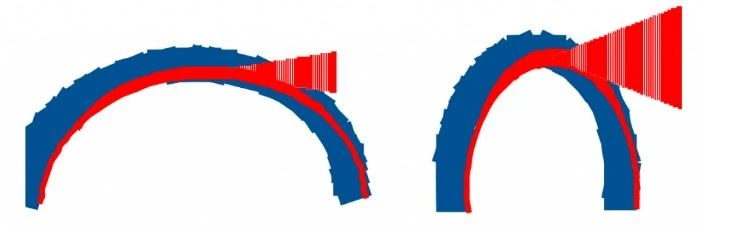
What Is Bend Radius?
To understand bend insensitive fiber patch cable, first you need to know what bend radius is. Bend radius is the minimum radius one can bend a pipe, tube, sheet, cable or hose without kinking it, damaging it, or shortening its life. The smaller the bend radius is, the greater is the material flexibility. When installing fiber optic jumper cables, you need to be careful enough not to exceed the cable bend radius.
Usually, if no specific recommendations are available from the cable manufacturer, the cable bend radius should be 20 times smaller than the cable's outside diameter when pulling the cable and 10 times the outside diameter when lashed in place. For example, while pulling a 2mm diameter cable, only a 40mm sweep is allowed; when lashed in place, make sure it's a 20mm sweep. For most of today's fiber patch cables, the bend radius is 30 mm. As we know, there are single-mode patch cable and multimode patch cord, and accordingly there are single-mode bend insensitive fiber patch cables and multimode bend insensitive fiber patch cables.