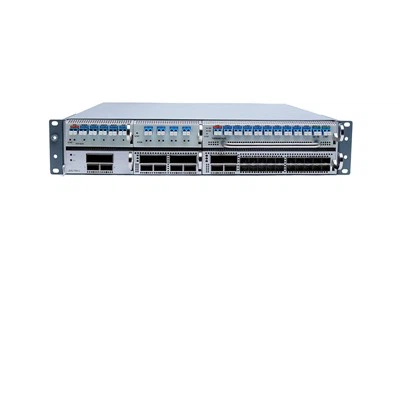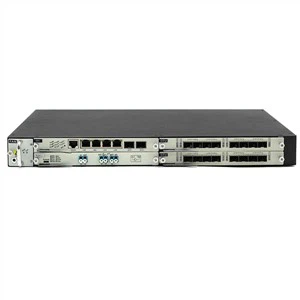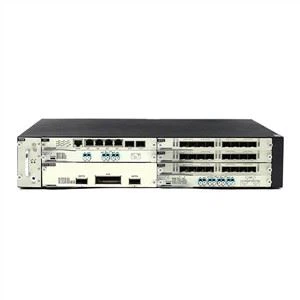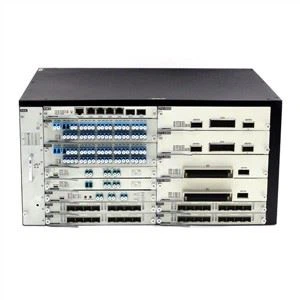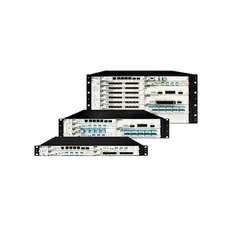
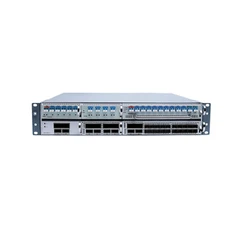

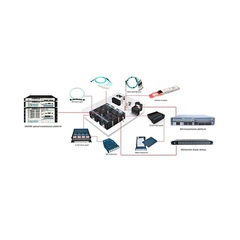


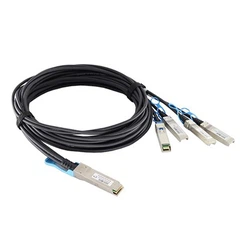
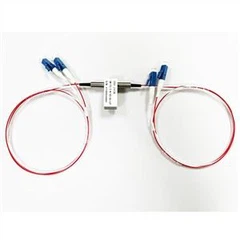
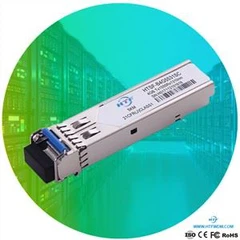


CWDM optical module is a kind of optical module using CWDM Technology, which is used to connect the existing network equipment and CWDM multiplexer / demultiplexer. When used with CWDM multiplexer / demultiplexer, CWDM optical module can increase network capacity by transmitting multiple data channels with single optical wavelengths (1270nm to 1610nm) on the same single fiber.

Features
From 1270nm to 1610nm, 18 channels are available
Uncooled MQW DFB LD
Optional package 1x9 / GBIC / SFF / SFP
Single supply + 3.3V or + 5V
Working temperature: 0 ° C ‐ 70 ° C (commercial grade); 40 ℃ - 85 ℃ (industrial grade)
According to Telcordia (Bellcore) gr ‐ 468 ‐ core
Class1 standard products, in line with IEC60825 ‐ 1 and IEC 60825 ‐ 2 requirements
RoHS compliant products
Application
CATV
FTTH
1g and 2G fibre channel
100m and Gigabit Ethernet
Synchronous optical network SONET
Security and protection system
Common types of CWDM optical modules
CWDM SFP
CWDM GBIC
CWDM X2
CWDM XFP
CWDM SFP+
What are the advantages of CWDM?
1. Low equipment cost can reduce the cost of network operation. Because of its small size, low power consumption, simple maintenance and convenient power supply, the CWDM equipment can use 220 V AC power supply. Due to the less number of wavelengths, the number of backup boards is small.
2. CWDM system can significantly improve the transmission capacity of optical fiber and improve the utilization of optical fiber resources.The construction of man is facing the shortage of optical fiber resources to a certain extent or the high price of renting optical fiber. At present, the typical coarse wavelength division multiplexing system can provide 8 optical channels, and according to ITU-T g.694.2 specification, it can reach up to 18 optical channels.
3. Small size and low power consumption. The laser of CWDM system does not need semiconductor cooler and temperature control function, so it can reduce power consumption obviously.The simplified laser module in CWDM system reduces the volume of the integrated module of optical transceiver, and the simplification of equipment structure also reduces the volume of equipment and saves room space.
Ring color of CWDM optical modules with different wavelengths

Optical module failure judgment steps
1. Test whether the optical power is within the range of the index requirements, if there is no light or
The phenomenon of low optical power. Treatment method:
a. Check the wavelength and measurement unit (DBM) of optical power selection
b. Clean the end face of optical fiber connector and optical port of optical module.
c. Check whether the end face of optical fiber connector is blackened and scratched, whether the optical fiber connector is broken, and replace the optical fiber connector for interchangeability test
d. Check for small bends in the fiber optic connector.
e. The hot swap optical module can be re plugged and tested.
f. Replace the optical module at the same port or replace the port with the same optical module.
2. The optical power is normal, but the link cannot be connected. Check the equipment
The transmission distance of optical module is limited mainly because of the loss and dispersion of optical signal in optical fiber.
Loss: the loss of light energy due to the absorption, scattering and leakage of the medium during the transmission of light in the optical fiber. This part of energy is dissipated in a certain ratio with the increase of transmission distance.
Dispersion: electromagnetic waves of different wavelengths travel at different speeds in the same medium, resulting in different wavelength components of optical signals arriving at the receiving end at different times due to the accumulation of transmission distance, resulting in the broadening of pulses and the inability to distinguish signal values.
These two parameters mainly affect the transmission distance of the optical module. In the practical application process, the link loss of 1310nm optical module is generally calculated as 0.35dbm/km, and that of 1550nm optical module is generally calculated as 0.20dbm/km. The calculation of dispersion value is very complicated and is generally only for reference. Therefore, users need to choose the appropriate optical module according to their actual networking situation to meet the requirements of different transmission distances.
There are two types of optical receiving devices (optical detection devices) used in optical communication, namely PIN photodiode and APD avalanche photodiode.
Type
| Response band
| Advantage | Disadvantage | Main applications |
GaAs/InGaAs PIN PD(No doubling effect)
| 830nm~860nm 1100nm~1600nm | The noise is low;The working voltage is low;Long working life;Easy to use and cheap | Low sensitivity | 155M~40G; Shorter distance(40KM) |
InGaAs APD PD(with multiplier effect)
| 1550nm | High sensitivity | High noise;The working voltage is high (50V ~ 200V); The price is more expensive | 1.25G~10G; long distance(120KM) |
Classification of optical devices:
According to the structure, it can be divided into: to device (Tosa, Rosa, Bosa); dip (or butterfly) device; surface mount device.
Tosa device: light emitting device;
Rosa device: optical receiving device;
Bosa device: optical transceiver integrated device.
Difference between CWDM optical module and other optical modules
1. What is the difference between CWDM optical module and common optical module?
● CWDM optical module uses less optical fiber than ordinary optical module, which can effectively improve the utilization of optical fiber resources.
● After the CWDM optical module is inserted into the switch, an optical module used in the CWDM / demultiplexer needs to be used. However, the ordinary optical module can run after it is directly inserted into the switch
● There are 18 channel wavelengths (1270-1610nm) in CWDM optical module, and the wavelength interval of each channel is 20nm. Thewavelength of common optical module is 850nm, 1310nm, 1330nm and 1550nm.
● As a low-cost WDM transmission technology for metropolitan area network access layer, CWDM is mainly used in telecommunication field, while ordinary optical module is more used in data communication field.
2. What is the difference between CWDM and DWDM?
The principle of DWDM optical module is similar to CWDM optical module, but DWDM optical module is for DWDM optical module, it has 40 common channels to choose from.
3. Where are CWDM and DWDM optical modules applied?
CWDM optical module is widely used in campus, data center, FTTH (fiber to home), 1g and 2G fiber channel, Gigabit Ethernet in man, security and protection system.
DWDM optical module is mainly used in long distance optical synchronous digital transmission network, such as Ethernet / fibre channel of 200km link and 80km link can also be used.
4. Which is better, CWDM optical module or DWDM optical module?
From the cost point of view, CWDM optical module is cheaper than DWDM optical module. CWDM optical module provides a convenient and low-cost solution for Gigabit Ethernet and fibre channel. DWDM, on the other hand, usually uses more intensive channel spacing and is used for large optical networks over long distances. If you want a long-distance SFP module, DWDM optical module is the ideal choice.
If you need anything, you can contact HTF Zoey.
contact:support@htfuture.com
Skype:sales5_ 1909,WeChat:16635025029