




QSFP56—Form Factor of 200G Transceivers.
Quad Small Form-Factor Pluggable (QSFP) was developed after SFP, which was originally designed to replace the single-channel SFPs with high-density optical modules. Due to the fact that it denotes four lanes for up to 4 wavelengths, it provides higher bandwidth capacity compared with the SFP modules.
Developed on the basis of QSFP, 40G QSFP+ arose and then 100G QSFP28 came into use for high-density applications. With the rising of data traffic in data centers and advanced network applications, the market is urgent to achieve higher-speed general availability. There is more addition to QSFP family form factors, such as 200G QSFP56 and 400G QSFP56-DD.
As an evolution of the previous 40G QSFP+ and 100G QSFP28, Quad 50 Gigabits Small Form-factor Pluggable (QSFP56) is the one designed for 200G Ethernet. QSFP56 denotes 4 x 50 to 56Gb/s in a QSFP form factor. Sometimes it can also be referred to as 200G QSFP for sake of simplicity.
QSFP56 optical modules are similar to QSFP ones in terms of size and form factor. Classified by distance, QSFP56 modules can be divided into QSFP56 CR, SR, DR, FR, LR, which enables different transmission distances over a single mode fiber (SMF) or multimode fiber (MMF).
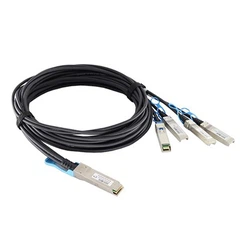
Generally, two QSFP56 modules can be used with an SMF or MMF to realize a 200G link. QSFP56 AOC/DAC is also a way to realize a 200G link by connecting QSFP56 ports on two devices in a simplified linking process. For bridging 200G QSFP56 ports with other speeds, there are 200G QSFP56 to 2x100G QSFP28 breakout cables and 200G QSFP56 to 4x50G SFP56 breakout cables to achieve 2x100G or 4x50G connections.