




Radius of curvature
The radius of curvature refers to the radius of the ferrule axis to the end face, as shown in the figure below, which is the radius of the curve of the end face of the ferrule. The curvature radius of the end face of the high-quality fiber jumper connector should be controlled within a certain range. If the radius of curvature is too small, greater pressure will be applied to the optical fiber, while too large a radius of curvature will not be able to apply pressure to the optical fiber, resulting in an air gap (ie, air gap) between the connector and the fiber end face. Regardless of whether the radius of curvature is too large or too small, it will cause light scattering or insufficient physical contact, which cannot guarantee the best transmission performance. Only a proper radius of curvature can ensure the correct pressure and the best transmission performance.

Vertex offset
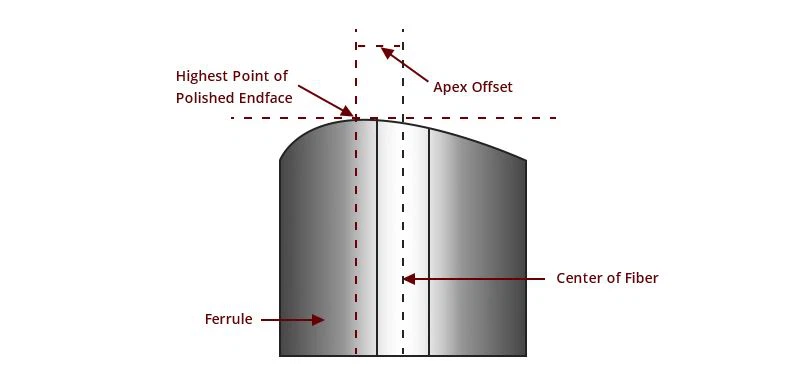
Vertex offset refers to the distance from the highest point of the ferrule end surface curve after grinding and polishing to the axis of the fiber core. This is a key item in the polishing process, and inaccurate polishing will cause the vertex to shift.
In technical standards, it is generally required that the apex offset of the fiber jumper is ≤50μm. If the tip offset is large, an air gap will be formed, resulting in high insertion loss (IL) and return loss (RL) of the fiber jumper. Under ideal conditions, the apex offset of PC and UPC optical fiber connectors is almost zero, because they make the end face of the ferrule perpendicular to the polishing surface during the polishing process, and the apex coincides with the core axis. But for the APC optical fiber connector, the end face and the optical fiber axis form an angle of 8 degrees, which is not completely perpendicular.
Fiber height
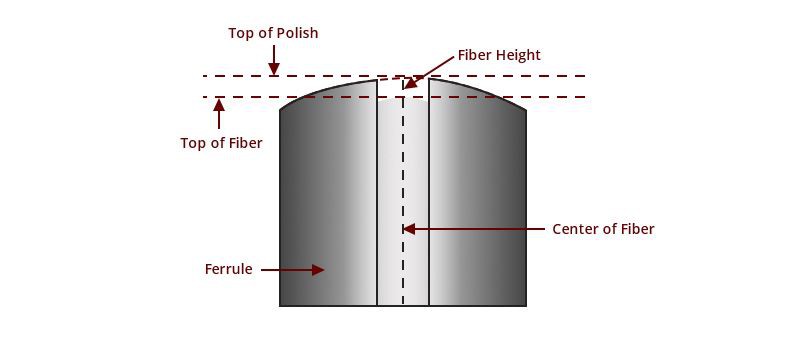
The fiber height is the distance from the fiber end face to the ferrule section, that is, the extension height of the fiber core to the ferrule end face. Similarly, the height of the optical fiber cannot be too low or too high. If the height of the fiber is too high, the pressure in the fiber will be increased when the two fiber connectors are connected, thereby damaging the fiber; if the height of the fiber is too low, there will be a gap when the two fiber connectors are connected, resulting in increased insertion loss. This must be avoided for transmissions with strict requirements for insertion loss.