




What is the fiber link budget?
The fiber link budget is the maximum signal loss allowed in the network and application. This value is calculated based on the actual network conditions and the loss specified by international standards. A complete optical fiber link includes optical fibers, connectors, and fusion splices, so when calculating the maximum loss of an optical fiber link, all these factors must be taken into account. The optical energy loss in the optical fiber communication link is composed of the loss of the optical fiber itself, the loss caused by the connector and the loss caused by the fusion splice. However, due to the uncertainty of the length of the optical fiber, the number of splices and the number of splices, the test standard of the optical fiber link is not fixed like a twisted pair. Therefore, the test standard of each optical fiber link must be calculated through calculation.

What is the calculation formula for fiber link loss?
Obviously, fiber link loss is the sum of fiber attenuation, connector attenuation, splice attenuation, and system margin loss:
Optical fiber link attenuation = optical fiber attenuation + connector attenuation + splice attenuation + system margin
Fiber attenuation = fiber attenuation coefficient (dB/km) × fiber length (km);
Connector attenuation = connector attenuation/piece × number of connectors;
Attenuation of welding point = attenuation of welding point/piece × number of welding points;
The system margin includes fiber jumper, fiber optic cable bending and unpredictable optical attenuation, etc. At least 3dB margin should be left.
The average attenuation of 1310nm wavelength under normal conditions:
Optical fiber attenuation: 0.35dB/Km; optical connector: 0.6dB/piece; welding point: 0.1dB/piece.
Average attenuation of 1550nm wavelength under normal conditions:
Optical fiber attenuation: 0.2dB/Km; optical connector: 0.35dB/piece; fusion point: 0.05dB/piece.
The picture below is a typical site case:
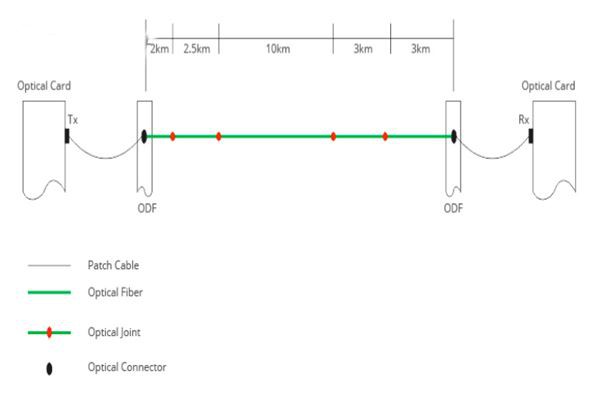
According to the above formula, the following results can be calculated:
For 1310nm wavelength:
Optical fiber link attenuation = 20.5Kmx0.35dB/Km+2x0.6dB+4x0.1dB+3dB=11.78dB;
For 1550nm wavelength:
Optical fiber link attenuation = 20.5Kmx0.22dB/Km+2x0.35dB+4x0.05dB+3dB=8.41dB;
Is it necessary to purchase a special reference jumper?
In the TIA/EIA568-B.3 and ISO11801 standards, the loss of a fiber coupling is required to be less than 0.75dB. The performance of fiber optic patch cords and adapters produced by most manufacturers can meet or exceed this requirement. However, what many people don't know is that the reference standards for cables and adapters have special requirements. In the IEC14763-3 standard, when the reference jumper and adapter are used, the coupling loss of multimode fiber is less than 0.1dB, and the single mode fiber is less than 0.2dB. Conventional fiber patch cords simply cannot meet this requirement. Therefore, it is necessary to purchase special reference jumpers for testing from manufacturers and test equipment manufacturers.