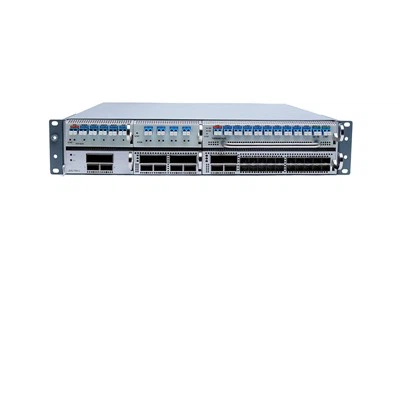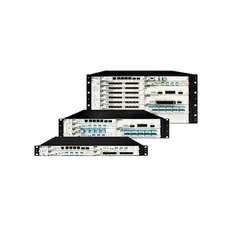
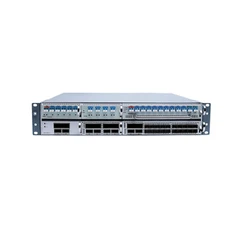

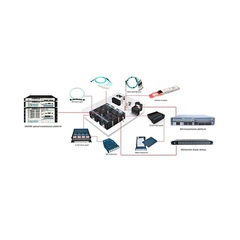


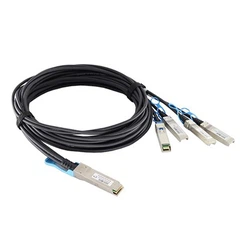


Optical fiber switch is a kind of high-speed network transmission relay equipment, also known as fibre channel switch and San switch. Compared with ordinary switch, it uses optical fiber cable as transmission medium. The advantages of optical fiber transmission are high speed and strong anti-interference ability.There are mainly two kinds of optical switch, one is used to connect the FC switch of storage. The other is Ethernet switch, the port is optical fiber interface, and the appearance of ordinary electrical interface is the same, but the interface type is different.
What is a fibre channel switch?
Fibre channel (FC) is designed for storage area network (SAN). It is a high-speed network technology used to connect computer data storage to servers. It supports three kinds of topology: the primary and the secondary, which are the arbitration point. In the switch fabric topology (only one switch is needed), all devices are connected and communicated through the switch. Fibre channel switch is a network device compatible with fibre channel protocol (FCP), and has the functions of high performance, low delay and lossless transmission in fibre channel architecture. As one of the main components of SAN, fibre channel switch plays an important role in interconnecting multiple storage ports and servers. Fiber channel has high transmission rate, low delay and strong scalability. Fibre channel switches have many different functions, including support for GBIC, redundant fans, power supply, zoning, ring operation and multiple management interfaces. Each function can increase the operability of the whole switching network. Understanding these characteristics can help users design a powerful and large-scale SAN.
How to choose a fibre channel switch?
Since fibre channel switch is the core component of SAN, it is very important to choose the most suitable switch.
SAN (storage area network) is a dedicated fibre channel network associated with storage devices and servers. It is composed of servers, fibre channel cards, fibre channel hubs / switches and fibre channel storage devices. SAN liberates high-capacity and long-distance connections from SCSI and avoids the shackles of Ethernet to enable high-speed data transmission.SAN consists of three basic components: interface (such as SCSI, fibre channel, ESCON, etc.), connection device (such as switching device, gateway, router, hub, etc.) and communication control protocol (such as IP and SCSI, etc.). These three components, together with additional storage devices and servers, constitute a SAN system. The key equipment of storage area network (SAN) is optical fiber switch. According to the fibre channel topology, the storage system is connected with the server by fibre channel switch to provide high-speed data transmission and sharing, LAN free data backup and storage consolidation. Fibre channel network plays an important role in storage system. It can discover everything in the storage system, and manage and control everything in the storage system.
What is an Ethernet switch?
Ethernet is defined by IEEE 802.3. Ethernet switch is a switch based on Ethernet to transmit data. Ethernet adopts LAN of shared bus type to transmit media. The structure of Ethernet switch is that each port is directly connected with the host and works in full duplex mode. Ethernet switch can connect many pairs of ports at the same time, so that each pair of hosts can communicate with each other as exclusive communication media to transmit data without conflict.
When deploying Ethernet network, Ethernet switch is essential. It is an infrastructure that bridges Ethernet devices together. Generally, LAN switches are likely to be Ethernet based switches with electrical or optical ports, with different number of ports. Ethernet switches have speeds of 10G, 25g, 40g, 100g and even higher.
Ethernet switch is the most popular, cheap and complete. Therefore, the application field is very wide, in large and small LAN can see their trace. Ethernet switch usually has several to dozens of ports, which is essentially a multi port bridge. In addition, its port rate can be different, and its working mode can also be different, such as providing 10m, 100m bandwidth, providing half duplex, full duplex, adaptive working mode, etc.

What is the difference between a fibre channel switch and an Ethernet switch?
Fibre channel (FC) is a serial I / O interconnection network technology that can support multiple protocols. Fibre channel switches are mainly used for San, while Ethernet switches are mainly used for LAN. But for storage devices, the dominant technology of data center is usually fibre channel. So what's the difference between fibre channel and Ethernet switch? The differences between them are analyzed in terms of reliability, transmission speed and cost
1. Reliability
Fibre channel switches are lossless, while Ethernet switches have the risk of frame loss. Fibre channel is usually compared to a lossless protocol for Ethernet. For a fibre channel switch, it can work smoothly without losing a frame, and the data frames must be transmitted in sequence. Fibre channel switches send signals when they connect with other devices, so these devices stop sending frames to avoid frame loss. In contrast to Ethernet, Ethernet begins to lose frames when the network is congested, and relies on the upper layer protocol (such as TCP) to ensure that everything works properly.
2. Transmission speed
The initial maximum data rate of a fibre channel switch is 1Gbps. Now it has developed to 128Gbps and can still use 8Gbps, 16Gbps and 32Gbps versions. The transmission speed range of Ethernet switch is from fast Ethernet (10 / 100Mbps), Gigabit Ethernet (10 / 100 / 1000Mbps), 10 Gigabit Ethernet (10 / 100 / 1000 / 10000Mbps) to even about 40 / 100Gbps. In terms of transmission speed, Ethernet switches seem to surpass fibre channel switches. And both of them are in high-speed evolution.
3. Cost
Cost is also a factor to be considered. In most cases, Ethernet switches are much cheaper than fibre channel switches. More importantly, maintenance is also a factor that should be considered. In a large IT system, if the Ethernet switch fails, most administrators can handle it. However, when there is a problem with the fibre channel switch, the enterprise needs to turn to the manufacturer. Compared with Ethernet switch, fibre channel switch adopts more complex design, which should ensure high availability of data storage and management function.
In short, there are significant differences between fibre channel switches and Ethernet switches. Fibre channel is a kind of network standard, which can interconnect host (server) and storage device. It's completely different from Ethernet. Storage network switch is different from Ethernet switch. Initially, the only transmission medium for fibre channel was fiber, but now twisted pair copper can also be used. This is the opposite of Ethernet, which initially runs on copper and then on fiber.
HTF's optical module products are suitable for switches., the quality is guaranteed, and the accessories are imported.
Contact: support@htfuture.com
Skype :sales5_ 1909,WeChat :16635025029