



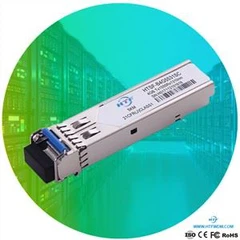


The full name of LWDM is LAN WDM. The 25G SFP28 LWDM module has 12 wavelengths, all of which belong to the O-band. Eight of them are standard wavelengths that are divided into the O-band spectrum according to 800GHz, and the remaining four wavelengths are 25G multiplexed. The four wavelengths of the CWDM optical module are 1269.23nm, 1332.41nm, 1313.73nm and 1291.10nm. Like the 25G WDM module, the 25G SFP28 LWDM optical module can also use WDM technology to multiplex multiple wavelengths onto a pair of optical fibers, thereby saving a lot of optical fiber resources.
From the wavelength diagram below, we can see that the wavelength interval of the 25G SFP28 LWDM optical module is 4nm, which is much narrower than that of the 25G CWDM optical module, so a larger wavelength shift will occur. Normally, the working temperature of SFP28 LWDM optical module is -40℃~85℃, and 1℃ will produce a wavelength shift of 1nm. Since the temperature span of 25G LWDM optical module is 125℃, SFP28 LWDM may produce 12.5nm The wavelength shift.
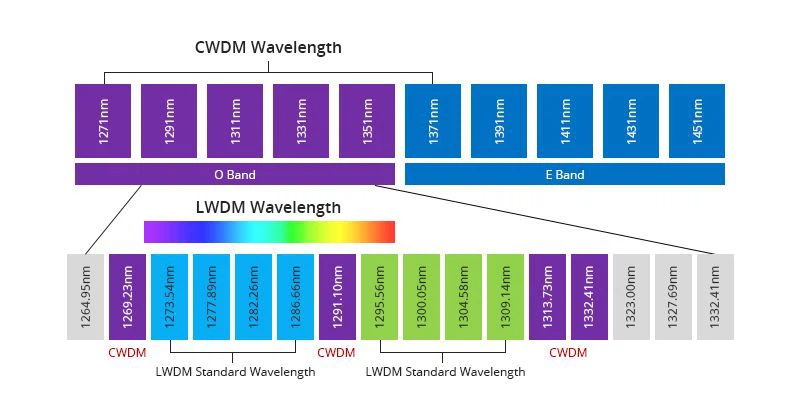
In order to ensure the stability of transmission, TEC temperature control is essential for 25G SFP28 LWDM optical modules, because it can form current through the movement of charge carriers in the conductor. When the direct current passes through two different conductor materials, the contact ends It will produce heat absorption or heat release, which can make the laser work stably at the set temperature for a long time, thereby stabilizing the wavelength, so that the 25G SFP28 LWDM optical module can ensure stable and accurate data transmission in a harsh environment.
25G SFP28 LWDM module in 5G fronthaul network