


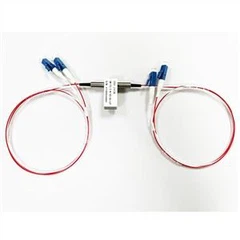
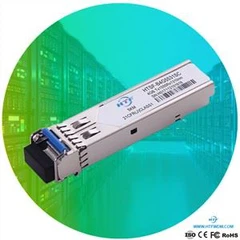


The 3-channel 25G CWDM is more economical and the 6-channel 25G LWDM has more performance advantages
The passive CWDM scheme faces the following problems:
1. The 200MHz carrier frequency for co-construction and sharing requires 2 cores /2 sets of systems;
2. Insufficient maintenance margin;
3. Pressure of product qualification rate;
4. Environmental test of high and low temperature.
Among the options to upgrade CWDM from 3*25G to support 6*25G, there are two solutions.
Solution1: C-Band, which requires a high-cost EML+PIN scheme, which is expensive and not feasible for the time being. Solution 2: Use the circulator and adopt the same wave scheme to extend the support for 12 waves on the basis of the existing CWDM6 wave, but it will face three challenges, namely, interpolation loss index, reflection influence and insufficient industrial chain support.
MWDM (Medium wavelength division multiplexing) scheme technology: based on CWDM's 6 waves, the optical module scheme adopts the low cost DML+PIN/APD+TEC (temperature control), which is high in cost. Combined and divided waves are realized by TFF (thin film filtering). As for the current industrial status of this scheme, the scheme of extending support for 10G channel is not clear. Theoretically, the existing industrial chain can be used to expand the 3-channel 10G or customize the 6-channel 10G expansion.
LWDM (Fine wavelength division multiplexing) technology: the working wavelength is located near the zero dispersion point, with low dispersion cost (<1dB) and good scalability. The optical module adopts low-cost DML+ low-cost PIN+TEC (temperature control), and the cost of 25G optical module is higher than that of CWDM. Combined and divided waves are realized by TFF (thin film filtering). According to the current progress, the optical module samples of this scheme have been developed and tested by 7 optical module manufacturers and 5 multiplexers/de-multiplexers. LWDM has excellent performance, and some manufacturers' CWDM has a high dispersion cost of long wavelength, which needs further optimization. In order to meet the requirements of 5G construction, LWDM can be collected and applied in scale at the earliest in the second half of the year.
G.Metro (DWDM dense wavelength division multiplexing) scheme: the 100GHz (0.8nm) wavelength interval DWDM technology is adopted, and the single-fiber BID structure is adopted. The interval between the first 20 waves and the last 20 waves is 700GHz. The scheme adopts the high-cost tunable EML+TEC+PIN scheme, and the technical scheme is feasible. However, the current industrial situation faces great cost pressure.
In general, THE DRAN prequel distance is short, and optical fiber direct drive is generally adopted, while BIDI is recommended. In the scenario of CRAN, the pretransmission distance is long. Due to limited optical cable resources, high cost and long construction cycle of new optical cable, WDM technology is generally adopted. For 3-channel 25G, CWDM is more economical; for 6-channel 25G, LWDM has performance advantages.
The prequel light module needs mainly CWDM and TFF needs greatly
By the end of March 2020, about 200,000 5G base stations had been opened across the country by the three major operators. A total of 500,000 base stations will be built nationwide, according to the three operators' 2020 5G construction plans. According to the third-party prediction, 6-7 million 5G base stations will be built in 5 years.
When it comes to 5G demand for light modules, the prequel aspect involves a variety of technologies. BIDI in the current DRAN scenario is very clear, while in the CRAN scenario, IT is mainly CWDM and may be LWDM or CWDM in the future, mainly depending on the development and cost of the industry. In terms of return transmission, the primary first-level return or access layer is mainly 25G and 50G, and 100G May be used for convergence and upward. Low-cost coherence technology is mainly adopted, requiring 80km or more, and 400G May be used in the future.
In terms of 5G's demand for multiplexers/de-multiplexers, THE main deployment mode of 5G is CRAN, and its prequel is mainly XWDM. The existing schemes are mainly CWDM, LWDM and MWDM. No matter which scheme is implemented, TFF filter should be adopted. The market has a huge demand for TFF.
4G changes life and 5G changes society. After the issuance of 5G licenses in China, the construction of 5G base stations has been intensified. We believe THAT 5G will soon enter our lives and become a new engine for the development of digital economy.