






Optical Specification
| Parameter | 8 Channel | ||
MUX | DEMUX | ||
Channel Wavelength (nm) | ITU 100GHz Grid | ||
Center wavelength Accuracy (nm) | ±0.1 | ||
Channel Spacing (nm) | 0.8nm (100GHz) | ||
Channel Passband (@-0.5dB bandwidth (nm) | >0.25 | ||
Insertion Loss (dB) | ≤3.0 | ||
Channel Uniformity (dB) | ≤1.0 | ||
Channel Ripple (dB) | 0.3 | ||
Isolation (dB) | Adjacent | N/A | >30 |
Non-adjacent | N/A | >40 | |
Inertion Loss Temperature Sensitivity (dB/℃) | <0.005 | ||
Wavelength Temperature Shifting (nm/℃) | <0.002 | ||
Polarization Dependent Loss (dB) | <0.1 | ||
Polarization Mode Dispersion | <0.1 | ||
Directivity (dB) | >50 | ||
Return Loss (dB) | >45 | ||
Maximum Power Handling (mW) | 300 | ||
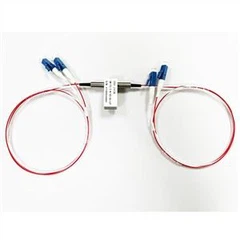
Passive DWDM MUX/DEMUX module
| Model | Channel | ILoss (dB) | Isolation(dB) | Wavelength (nm) | ||
MU/DMU | MU+DMU | Adjacent | Non-adjacent | |||
HT6000-ODM08 | 8CH MUX and DEMUX | ≤3 | ≤3.5 | 30 | 40 | 100GHZ ITUT Grid C-Band |
HT6000-OMU08 | 8CH MUX | ≤3 | ≤3.5 | 30 | 40 | 100GHZ ITUT Grid C-Band |
HT6000-ODU08 | 8CH DEMUX | ≤3 | ≤3.5 | 30 | 40 | 100GHZ ITUT Grid C-Band |
How dual fiber 8ch DWDM Mux Demux connect?

Questions & Answers
Q1: How many channel for the DWDM can achieve?
A1: DWDM wavelengths are packed tightly together over the C-band,
In 100GHz grid(0.8nm) can achieve up to 48 wavelengths,
In 50GHz grid(0.4nm) can achieve96 wavelengths.
Q2: What DWDM Mux Demux usually used for and application enviroment?
A2: It widely use for long-haul transmission. The protocol is transparent and suit applications including 10/1G Ethernet, SDH/SONET, 16/8/4/2/1G Fibre Channel, FTTx and CATV.
Q3: Can you provide customized sevices for DWDM Mux Demux?
A3: Yes, HTFuture will customize your Mux perfectly tailored to your specific needs. Any specific wavelength, any connector, any housing and any special ports can be achieved.
Q4: Passive DWDM vs CWDM – Which one is better?
A4: For short distance (like 70km), low capacity, sub-10G. CWDM works better, as convenient and cost-efficient.
If you want speed protocols of up to 100G/200G per channel, for long haul applications, DWDM works better.
Q5: Can we order one pair to test first?
A5: Yes, Without MOQ to support you.
Q6: What certification it have?
A6: CE, ROHs, FCC, ISO.



Know more about DWDM Backbone Networks
The DWDM-based network structures can be divided into three classes, which are simple point to point DWDM link, DWDM wavelength routing with electronic TDM and switching/routing backbone network and all optical DWDM network.
1. Simple Point to Point DWDM Link
In this architecture, the electronic nodes can be SONET/SDH switches, Internet routers, ATM switches, or any other type network nodes. The DWDM node consists of typically a pair of wavelength multiplexer / de-multiplexer (lightwave grating devices) and a pair of optical-electrical/ electrical-optical converters. Each wavelength channel is used to transmit one stream of data individually. The DWDM wavelength multiplexer combines all of the lightwave channels into one light beam and pumps it into one single fiber. The combined light of multiple wavelengths is separated by the demultiplexer at the receiving end. The signals carried by each wavelength channel are then converted back to the electrical domain through the O/E converters (photo detectors). In this way, one wavelength channel can be equivalent to a traditional fiber in which one light beam is used to carry information. It is worth noting that the wavelength channels in one fiber can be used for both directions or two fibers are used with each for one direction.
2. Wavelength Routing With Electronic TDM
In this structure, wavelength routers are used to configure or reconfigure the network topology within the optical domain and the TDM network nodes are used to perform multiplexing and switching in the electrical domain. This combined optical and electrical network architecture can be applied in SONET/SDH in which the electrical TDM network nodes would be SONET switches, or in the Internet in which the electrical TDM network nodes would be the Internet routers. The architecture can also be used in an ATM network where the electrical TDM network nodes would be ATM switches.
3. All Optical DWDM Network
As it is seen that the electrical TDM/switching nodes can be of any kind, such as SONET/SDH switches, Internet routers, and ATM switches. This indicates that the all-optical TDM nodes in the all-optical architecture can be optical SONET/SDH switches, or all-optical ATM switches, or all-optical Internet routers. Different types of all-optical TDM/switch nodes can also be in one network, provided the protocol conversions are implemented. In fact, the optical TDM/switch node and the wavelength router in one routing site can be combined into one all-optical switching node that not only forwards packets through time domain multiplexing but also selects the light path intelligently according to the availability and traffic loads of the links.
Hot Tags: 8 channels DWDM mux demux, China, manufacturers, suppliers, factory, customized, buy, price, bulk, compatible brand, 40 Channel AWG Module Rack Mount, 4 Channels DWDM for Optical Networking, 8 Channels Single Fiber DWDM Mux, 8 Channels DWDM Mux Demux, DWDM MUX DEMUX Dual Fiber, 16 Channels Module Mux Demux


