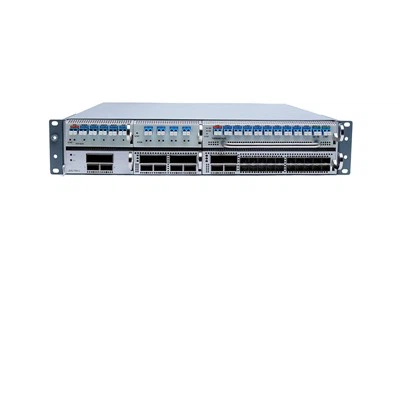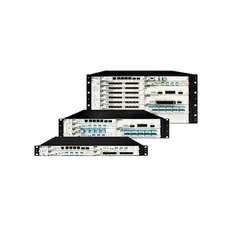
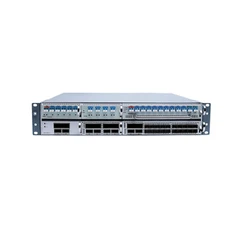

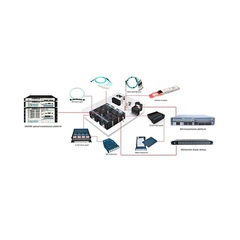


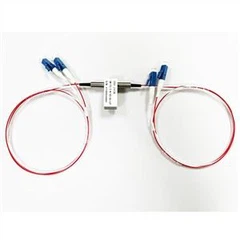


WDM wavelength division multiplexing refers to carrying multiple wavelength (channel) systems on one optical fiber, converting one optical fiber into multiple "virtual" fibers, and each virtual fiber working independently at different wavelengths. Due to the economics and effectiveness of WDM system technology, it has become the most widely used optical wave multiplexing technology in the current optical fiber communication network.
WDM usually has three multiplexing methods, namely wavelength division multiplexing at 1310nm and 1550nm, coarse wavelength division multiplexing (CWDM) and dense wavelength division multiplexing (DWDM).
(1) 1310nm and 1550nm wavelength division multiplexing
This multiplexing technology used only two wavelengths in the early 1970s: a wavelength of 1310nm window and a wavelength of 1550nm window. The use of WDM technology to achieve single-fiber dual-window transmission is the initial use of wavelength division multiplexing.
(2) Coarse wavelength division multiplexing (CWDM)
CWDM technology refers to the WDM technology with large adjacent wavelength intervals. The distance between adjacent channels is generally greater than or equal to 20nm. The number of wavelengths is generally 4 or 8 waves, with a maximum of 18 waves. CWDM uses 1200nm ~ 1700nm window.
CWDM uses non-refrigerated lasers and non-optical amplifier devices, the cost is lower than DWDM; the disadvantage is that the capacity is small and the transmission distance is short. Therefore, CWDM technology is suitable for short-distance, high-bandwidth, and dense access point communication applications, such as network communication within or between buildings.
(3) Dense Wavelength Division Multiplexing (DWDM)
Simply put, DWDM technology refers to the WDM technology with a small interval between adjacent wavelengths, and the working wavelength is located in the 1550nm window. It can carry 8 ~ 160 wavelengths on one fiber. Mainly used in long-distance transmission systems.