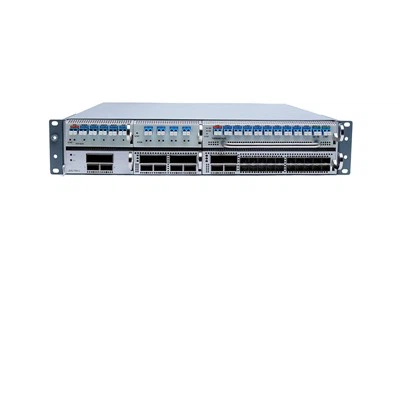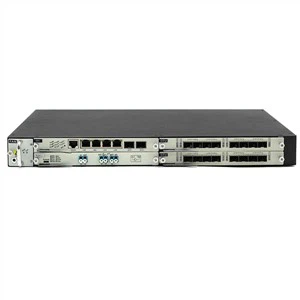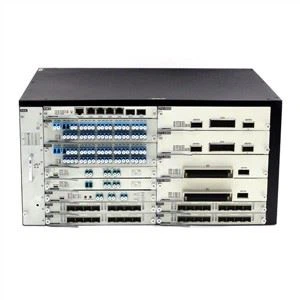





5G network is divided into three parts, namely core network, carrier network and wireless network, in which the role of the carrier network is to achieve high bandwidth through the deployment of higher throughput IPRAN (PTN), and the deployment of more OTN to achieve low latency.
It is predicted that the growth of global mobile data traffic will be more than 200 times from 2010 to 2020, and the surge of mobile data traffic will be supported by the carrying network. We can judge the product selection of 5G carrying network through the calculation of single station traffic. How much bandwidth do the convergence layer and core layer need? Take a large metropolitan area network as an example, there are 12,000 5G base stations, and the bandwidth convergence ratio is 6:1. The core layer's bandwidth requirements will exceed 6T initially and 17T in maturity. Therefore, 25G/50G rate interface is required to be introduced in the access and convergence layer of 5G middlehaul bearing network, while 100G and above rate interface is required in the core layer.
From 4G to 5G, the improvement of network demand has brought revolutionary changes to network technology and significant changes to industrial structure. The biggest variable between 4G and5G lies in the fronthaul. As the number of antenna channels changes from 2 to 64 channels, the number of antenna channels fully increases by 32 times, resulting in a substantial increase in the fronthaul flow.
In 4G network, 10G optical module is mainly used. Since only 1.25g of 4G single RRU bandwidth is needed, a large number of chain-like networking structures are adopted in the fronthaul direction to save fiber resources and reduce the difficulty of deployment. For 5G, the minimum prequel bandwidth requires 25G optical module, and the price of 100G optical module is slightly higher than that of 25G optical module. Therefore, the prequel may choose 25G optical module as the solution. At the same time, due to the influence of 25G optical module, the previous chain-type networking cannot be chosen, and star networking must be adopted.
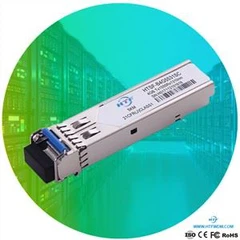
The above 25G optical modules provided by HTF have been tested by the real machine, with high compatibility and good stability, which can effectively help users improve the benefits. Not only that, HTF can also provide you with a variety of types of optical module system solutions and customized services (OEM customized according to your special needs) to help you build a complete infrastructure communication system.