


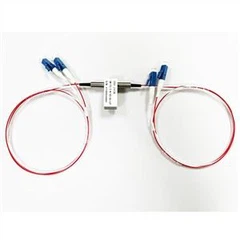


As an important link of network equipment interconnection, optical fiber jumper is a kind of passive optical device which is widely used in optical communication. Among them, the connector performance at both ends of the jumper directly affects the optical transmission quality.
What is insertion loss?
Insertion loss (IL) mainly refers to the measurement of the loss of light between two fixed points in an optical fiber. In the field of telecommunications, insertion loss refers to the loss of signal power due to the insertion of a device somewhere in the transmission system, usually refers to attenuation, which is used to express the ratio of output optical power and input optical power of the port, in dB. Obviously, the lower the insertion loss is, the better the insertion loss performance is. It can be understood as the loss of optical power caused by the intervention of optical devices in optical communication system. The recommended maximum DB loss of data center optical fiber wiring: the maximum is 15dB for LC multimode optical fiber connector, 15dB for LC single-mode connector, 20dB for MPO / MTP multimode optical fiber connector and 30dB for MPO / MTP single-mode optical fiber connector.
What is return loss?
When the optical fiber signal enters or leaves an optical component (such as optical fiber connector), the discontinuity and impedance mismatch will lead to reflection or return. The power loss of the reflected or returned signal is called return loss (RL). The insertion loss is mainly to measure the result signal value when the optical link encounters the loss, while the return loss is to measure the reflection signal loss value when the optical link encounters the component access.
Return loss refers to the power loss caused by the reflection of some signals back to the signal source due to the discontinuity of the transmission link. This discontinuity may not match the terminal load or the device inserted in the line. Return loss is easily misunderstood as the loss caused by return. In fact, it refers to the loss of return itself, that is, the larger the return is lost, the smaller the return is. It represents the ratio of reflected wave power to incident wave power at the transmission line port, in dB, which is generally positive. Therefore, the higher the absolute value of return loss, the smaller the amount of reflection, the greater the signal power transmission, that is, the higher the RL value, the better the performance of the optical fiber connector.
Factors affecting insertion loss and return loss
Single optical fiber jumper direct connection is the most ideal optical fiber path, at this time, the loss is minimum, that is, a direct connection optical fiber between a and B ends is not interfered. However, in general, fiber optic networks need connectors to achieve modularization and path splitting. Therefore, the ideal performance of low insertion loss and high return loss will be greatly reduced due to the following three reasons.
1.End face quality and cleanliness
Fiber end defects (scratches, pits, cracks) and particle contamination will directly affect the performance of the connector, resulting in higher insertion loss and lower return loss. Even the tiny dust particles on the 5 micron single-mode fiber core may eventually block the optical signal, resulting in signal loss. Any abnormal situation that hinders the transmission of optical signal between fibers will have adverse effects on these two losses.
2. The optical fiber is broken and poorly inserted
Sometimes, although the fiber has broken, it can still guide light through, which will also lead to poor IL or RL. As mentioned in the picture at the beginning of the article, the APC connector is connected with the PC connector, one is an angle of 8 ° and the other is the grinding angle of the micro arc surface. Light may pass through the two connectors in a short time, but at the same time, it will cause large insertion loss and low return loss. It may also cause the two optical fiber end faces can not be precisely butted, so that light can not pass through normally.
3. Exceeding bending radius
Optical fiber can be bent, but bending too much will cause a significant increase in optical loss, and may directly lead to damage. Therefore, it is recommended to keep the radius as large as possible when the optical fiber needs to be coiled. The general advice is not to exceed 10 times the diameter of the jacket. Therefore, the maximum bending radius is 20 mm for the jumper with 2 mm outer jacket.
4. Alignment and positioning deviation of connector insert
The main function of the optical fiber connector is to quickly connect two optical fibers, ensure the accurate alignment between the two fiber cores, realize the precise docking of the two fiber ends, and make the optical power output from the transmitting fiber coupled to the receiving fiber to the maximum extent. In general, the smaller the diameter of the ferrule hole is, the more central the core is. If the ferrule hole is not completely centered, the core contained in it will not be completely centered. Therefore, the insertion loss and return loss will be greatly affected when there is no precise alignment between the cores, that is, the alignment deviation of the connector core.
5. End face physical contact air gap
The optical fiber connectors are fixed by adapter, which belongs to physical connection, but it is not real physical contact, and there will be gap between the contact end faces of the two connectors. The smaller the air gap is, the better the insertion loss and return loss are. The air gap between the end faces of optical fiber connectors changes with different grinding methods. In general, the typical insertion loss of optical fiber connector with physical contact (PC), ultra physical end face (UPC) and inclined physical contact (APC) grinding is less than 0.3 dB. Among them, the UPC connector has the lowest insertion loss due to the minimum air gap, while the APC connector has the highest return loss due to the inclined fiber end. Choosing the right type of fiber connector can help you achieve better optical transmission quality.

How to optimize the loss of optical fiber connector?
The use of appropriate high-quality optical fiber connectors is conducive to the long-term stable operation of high-speed transmission system. Here are some suggestions to help optimize the insertion loss and return loss:
● Make sure the optical fiber connector is clean before use. If contaminated, clean with suitable tools.
● When using, avoid applying any improper pressure on the optical fiber, and do not bend the optical fiber beyond its maximum bending radius.
● Bending, coiling, welding and coupling of optical fiber jumpers should be avoided as much as possible, otherwise the optical signal may be refracted when passing through the optical fiber cladding. If the optical fiber needs to be coiled, a large coil radius should be maintained.
● Use factory terminated fiber. These terminations are carried out under strict control and are usually guaranteed by the manufacturer.
● Reasonable balance between power loss and fiber cost, the use of cheap and inferior fiber may cause greater cost loss in the future.
Use factory terminated fiber. These terminations are carried out under strict control and are usually guaranteed by the manufacturer. Reasonable balance between power loss and fiber cost, the use of cheap and inferior fiber may cause greater cost loss in the future.
Combining the insertion loss and return loss two important optical indexes, we can more accurately evaluate the transmission efficiency and performance of optical fiber, and judge whether there is impedance mismatch in the pins of receiver and transmitter, as well as through holes, connectors and other discontinuities. Understanding the insertion loss and return loss of optical fiber connector will help you to deploy a better optical transmission network.
HTF's products quality is guaranteed, and the accessories are imported.
Contact: support@htfuture.com
Skype :sales5_ 1909,WeChat :16635025029