


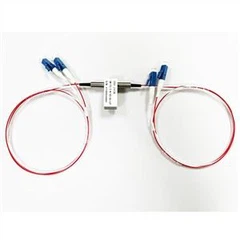
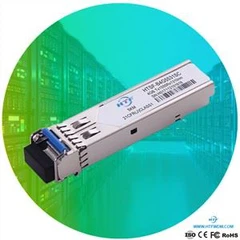


Different from the ordinary optical module (using dual fiber to transmit data, one for transmitting and one for receiving), the optical module using bidi technology allows interconnected network devices such as switches and routers to send / receive data on a single fiber. With bidi optical module, users can simplify their network wiring system, increase network capacity and reduce network cost. Therefore, the product is also concerned by 5G applications.
Types and applications of bidi optical modules
In the market, bidi optical module adopts two different interface designs, namely bidi single fiber bidirectional optical module and bidi dual fiber bidirectional optical module.
Bidi dual fiber bidirectional optical module
Generally, bidi single fiber bidirectional optical module has only one port. The optical module can be used with LC simplex single-mode fiber. The products in the market include 1G SFP bidi optical module, 10G SFP + bidi optical module, 25G SFP28 bidi optical module, 50G QSFP28 bidi optical module, etc. (visit bidi product list for more information).
At present, bidi single fiber bidirectional optical module is usually used in ISP network, FTTx or data center network with 1 / 10 / 25 / 50Gbps transmission rate. Bidi single fiber bidirectional optical module can be installed in switches, optical fiber transceivers, OEO converters and other devices to provide high-speed and stable optical transmission.
Bidi dual fiber bidirectional optical module
40G QSFP + bidi dual fiber bidirectional optical module is a special bidi optical module, which is designed with LC duplex interface. As shown in Figure 5, the 40G bidi optical module uses two 20Gbps channels for data transmission, and each channel can simultaneously send and receive signals through LC duplex multimode optical fiber (850nm, 900nm). At this time, the transmission distance using OM3 jumper is 100m, and the transmission distance using OM4 jumper is 150m.
40G bidi optical module is an efficient solution for upgrading 10G-40G network. As shown in Figure 6, MTP jumper is usually used to connect 40G optical module (such as 40G SR4, 40G PLR4 optical module, etc.) for data transmission, while traditional 10G network transmission uses LC jumper for data transmission. In this case, if users plan to upgrade the existing 10G network to 40G, they need to upgrade the existing cabling system, which will increase the cost of user network. Now, if the 40G QSFP + bidi optical module is used for network upgrade, users can continue to use the existing 10G LC optical fiber wiring, so as to realize the migration of the wiring system with zero cost.
Note that the bidi optical modules must be used in pairs, that is, the wavelengths of the transmitting end (TX) and the receiving end (Rx) of the interconnected bidi optical modules must correspond one to one. For example, the TX end wavelength of 10G SFP + bidi is 1310nm and the RX end wavelength is 1490nm. This module can only be used with the SF + bidi optical module with the TX end wavelength of 1490nm and the RX end wavelength of 1310nm.
Bidi optical module will play an important role in 5G applications
In 5G applications, the forward, intermediate and return networks need high-speed, low delay and high reliability data transmission to support telemedicine, automatic driving and other applications. Considering the need of saving fiber resources and reducing cost, high-speed 25 / 50G bidi optical module is the best choice for data transmission in 5G communication physical layer.
In 5G forward network, active antenna unit (AUU) uses optical fiber jumper to connect with distribution unit (DU) point to point, so a large number of jumpers are needed to complete the connection. At the same time, 5G has at least 10 times higher download rate than 4G, so it requires higher transmission rate. Considering the above two factors, 25G bidi optical module is an excellent choice for 5G forward network.
In 5G medium transmission and return network, the 50G bidi optical module designed with PAM 4 can meet the 100 / 200G transmission rate requirements of its aggregation layer and core layer, so as to meet the load requirements of 5G bearer network for large capacity and network slice.
Bidi optical module is a feasible solution to help users simplify network wiring and improve network capacity. At the same time, the high-speed 25 / 50G bidi optical module can provide faster and more stable data transmission for 5G network, which is a high-quality choice for 5G network deployment.
HTF's products quality is guaranteed, and the accessories are imported.
Contact: support@htfuture.com
Skype :sales5_ 1909,WeChat :16635025029