



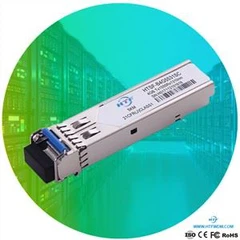


1.Bidi SFP optical module
Bidi-sfp optical module: bidi (bidirectional), namely: single fiber bidirectional. It uses WDM (wavelength division multiplexing) technology to transmit and receive different central wavelengths in two directions, so as to realize bidirectional transmission of optical signals by one fiber. There are two common schemes for transmission distance within 40km: 1310nm / 1550nm: 1310nm / 1490nm, and the common scheme with transmission distance over 40km: 1550nm / 1490nm.
2. Bidi + SFP module
The SFP + bidi single fiber bidirectional 10G Optical module supports 10g transmission rate. The emission part adopts 1330nm / 1270nm DFB laser module with low jitter and high performance, which can support the maximum transmission distance of 10km. It supports hot swap, single fiber bidirectional transmission, DDM, and commercial temperature range (0 ℃ ~ + 70 ℃). It is mainly used in 10GBASE, LR Ethernet, 10g LW fibre channel and other fields.
3. Bidi XFP optical module
Bidi XFP 10km single fiber bidirectional 10G Optical module is the same as bidi SFP + optical module.
4. Bidi x2 optical module
Bidi x2 tx1330nm / rx1270nm optical module, 10GB bidi x2 simplex SC 1270 / 1330nm 0-160km optical module, bidi x2 series single-mode transceiver is a small size pluggable module for duplex optical data communication, such as 10gbase-lr / lwae defined in IEEE 802.3, which supports hot swap.
How does the single core optical module work
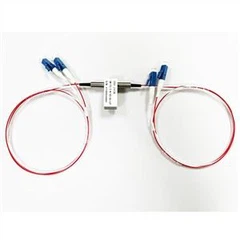
The main difference between single core optical module and traditional dual fiber bidirectional optical module is that single core optical module is equipped with wavelength division multiplexing (WDM) coupler, that is, duplexer. According to the different wavelengths, the data transmitted on a single optical fiber are merged and separated. Because of this, single core optical module is also considered as WDM optical module.