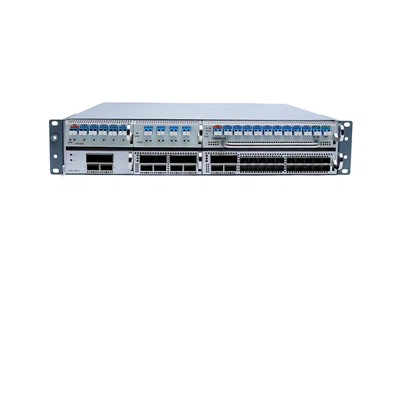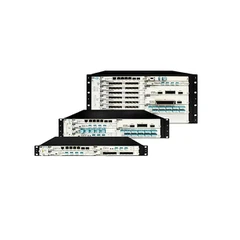
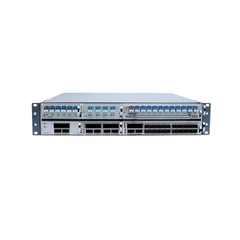

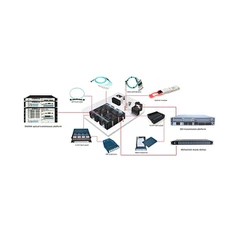


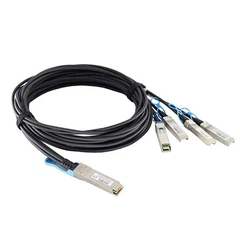


As a device that can mix all-optical port and photoelectric port, switch is suitable for a variety of occasions. Therefore, its classification is also very detailed. From the perspective of application, it can be divided into data switch and telephone switch. The data switch can be divided into optical fiber switch, Ethernet switch and port switch. And fiber switches can be divided into FC switches and fiber Ethernet switches.
What is an optical fiber switch?
Optical fiber switch is a relay device with optical fiber cable as the transmission medium, supporting optical fiber channel optical module, which can be used in high-speed network equipment. There are two main types of fiber switches, one is the FC switch for storage network, which is suitable for FC SAN environment, and the other is the fiber Ethernet switch with pluggable fiber, which is suitable for Ethernet environment.
What is an FC switch?
FC (Fiber Channel) switch adopts the storage LAN of Fiber Channel, which is mainly used for the connection, communication and distinction between storage and devices. SAN is generally used to improve the transmission bandwidth of hard disk protocol, focusing on the fast, efficient and reliable transmission of data, so that storage space can be more fully utilized, as well as more effective installation and management. FC switches run on a switched SAN. Therefore, FC switches are also called "SAN switches" and "fiber channel switches".
What is a fiber optic Ethernet switch?
Fiber optic Ethernet switches mainly refer to high performance Ethernet switches that can be used for management. Manageable switches are generally used in the convergence layer and core layer of large and medium-sized networks, depending on the application requirements in the access layer. Users can choose all-optical port configuration or optoelectronic port hybrid configuration, access to fiber media optional single-mode or multi-mode fiber. The switch supports both network remote management and local management to monitor the working state of the port and to set up the switch.
Features of fiber switches
(1) With advanced hardware processing capacity, rich business characteristics, can provide a large capacity access port.
(2) Stackable design, protect user investment, form a logical entity, so that the device capacity can be according to the development of the network and smooth expansion.
(3) The use of high performance, low power processor, can meet the needs of most enterprise network and network operators’ network deployment; support the green Ethernet line sleep ability.
(4) To support multiple operating systems, and meet the diverse needs of data center operators and telecom operators, with high performance and rich business processing capability, flexible network deployment, complete security and QoS control strategy, can satisfy the user the use of campus network density access, high performance requirements, with green, environmental protection, energy saving new Internet access.
(5) To meet the needs of urban Ethernet access and convergence, enterprise network access and convergence and data center and other occasions, with large capacity, high density port.
Usage scenarios of optical fiber switches
Because of the high cost of optical fiber switches, optical fiber switches are mainly used for the connection between core switches and backbone switches, or for the cascade between backbone switches. Particularly suitable for optical switches, fiber optic port information point access distance beyond the five kinds of line needs access distance, resistance to electromagnetic interference and communication security and other occasions, so for a data center, business rooms, Internet, operators, government, finance, energy, manufacturing, education, transportation and other industry users to build an end-to-end solutions.