


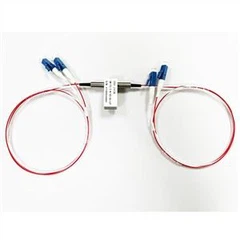
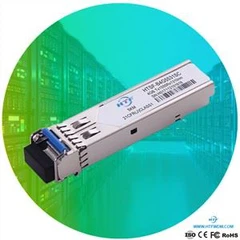


The erbium-doped fiber amplifier has an isolator at the input end and the output end, the purpose is to make the optical signal unidirectional transmission. The pump exciter wavelength is 980nm or 1480nm, which is used to provide energy. The role of the coupler is to couple the input optical signal and the pumping light into the erbium-doped fiber, and transfer the energy of the pumping light to the input optical signal through the action of the erbium-doped fiber to realize the energy amplification of the input optical signal.
The application of erbium-doped fiber amplifier in dense wavelength division multiplexing system is mainly to compensate the fiber loss in transmission. According to the position and role of the amplifier in the system, it can be divided into the following three types:
1. A power amplifier (booster-Amplifier), after the combiner, is used to increase the power of multiple wavelength signals after the multiplexing, and then transmit it. Since the signal power after the combining is generally relatively large, so, The noise figure and gain requirements of a power amplifier are not very high, but it requires a relatively large output power after amplification.
2. Line amplifier (Line-Amplifier), after the power amplifier, is used to periodically compensate the transmission loss of the line. Generally, it requires a relatively small noise index and a large output optical power.
3. Pre-amplifier (Pre-Amplifier), which is in front of the demultiplexer and after the line amplifier, is used for signal amplification to improve the sensitivity of the receiver (in the case that the optical signal-to-noise ratio (OSNR) meets the requirements, a larger input power It can suppress the noise of the receiver itself and improve the receiving sensitivity). The noise index is very small and the output power is not much required.