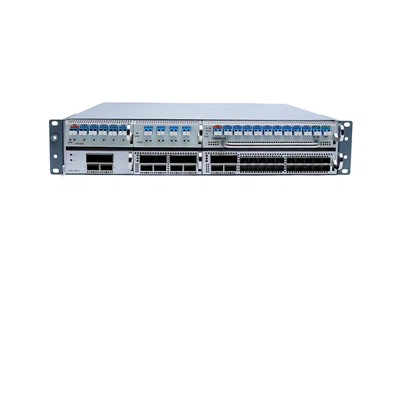



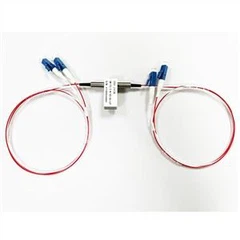
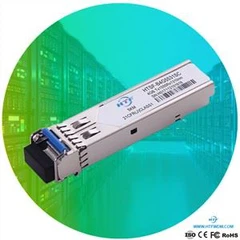


The CWDM system components are passive and require no power supplies.
CWDM System Components
Generally, there are three basic components in a CWDM system, which are the multiplexer/demultiplexer (Mux/Demux), the drop/pass module and drop/insert module. CWDM applications are described in terms of an east-west connection. Different colors represent individual channels. Westbound traffic is represented by dashed lines, while eastbound traffic is shown with solid lines.
Mux/Demux
The Mux/Demux based on film filter is the most mature component used in CWDM system. It combines different channels onto a single outbound (TX) fiber. Simultaneously, the Mux/Demux receives the same channels from a single inbound (RX) fiber, separates them into individual wavelengths, and delivers each to the appropriate local interface.
The four-channel Mux/Demux can be configured to support additional channels through the expansion port. By cascading the modules in series, you can increase the total number of available network channels. The channels connecting to the expansion port must differ from those on the Mux/Demux to which they are being cascaded.
CWDM is a simple and affordable method to maximize existing fiber by decreasing the channel spacing between wavelengths. Since CWDM is a passive technology, it allows for any protocol to be transported over the link, as long as it is at a specific wavelength. Because the multiplexers simply refract light at any network speed, regardless of the protocol being deployed, CWDM can help to future proof the networking infrastructure. In all, CWDM is a low-cost and effortless technology to implement.