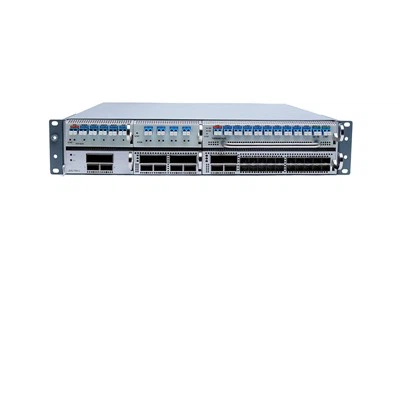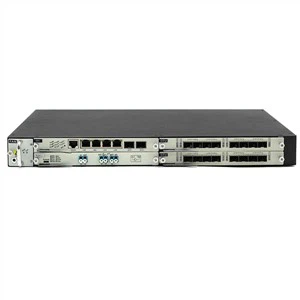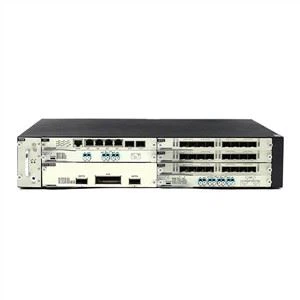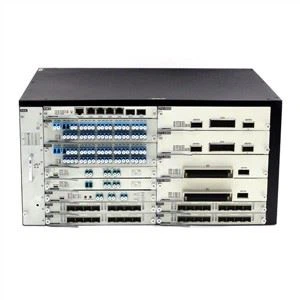



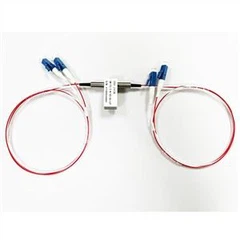
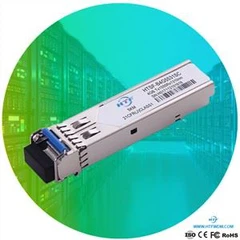


With the growth of voice service and the emergence of various new services, especially the rapid development of IP technology, network capacity will be seriously challenged. Traditional transmission network capacity expansion methods are no longer applicable to the current environment. The generation of DWDM equipment not only greatly increases the network capacity, but also makes full use of the bandwidth resources of optical fiber, reducing the waste of network resources.
Purpose of DWDM equipment
DWDM equipment can be generally divided into optical terminal multiplexer (OTM), optical line amplifier (OLA), optical splitter multiplexer (OADM) and point repeater (REG) according to the purpose.
(1) Optical terminal multiplexer (OTM)
In the sending direction, the OTM multiplexes the 1-6 (or 12) wavelength stm-16 signal multiplexer into the DWDM main channel and then amplifies it with a 5 wavelength optical monitoring channel. In the receiving direction, the OTM first takes out the optical monitoring channel, then amplifies the DWDM main channel, and demulsifies the stm-16 signal into 16 (or 32) wavelength through the wave splitter.
(2) Optical amplifier (OLA)
OLA in each transmission direction first takes out the optical monitoring channel (OSC) and processes it, then amplifies the main channel, and then connects the main channel with the optical monitoring channel and feeds it into the fiber line. It USES a pair of WPA+WBA in each direction for optical line amplification, and can also use a single wave-length preamplifier (WPA) or wavelength power amplifier (WBA) for one-way optical line amplification.
(3) Optical distributor multiplexer (OADM)
High equipment after the light signal from the receiving circuit, light extraction to monitor channel, then the main optical channel with WPA pre amplifier, through MR2 unit contains 16 or 32 STM - 16 light signals and according to the wavelength removed after a certain number send equipment, to insert the wavelength of the MR2 unit directly into the channel, after the power amplifier inserted into the local optical channel monitoring.
(4) Electric repeater (REG)
Electrical repeater (REG) is an electrical regeneration repeater used for pulse regeneration shaping, mainly through optical/electrical transformation (O/E), electrical signal sampling, decision, regenerative shaping, electrical/optical transformation (E/O) and other processing; in order to achieve the purpose of not accumulating line noise, ensure the transmission signal waveform intact.
The best choice for DWDM device transmission
DWDM network has become the best choice for high capacity and long distance data transmission. However, there are many types of equipment to realize WDM and transmission, and various functional modules have various methods to realize it. The specific equipment to be used should be decided according to field conditions and system performance priorities.
At the same time, the nonlinear effect of fiber is the main factor that affects the performance of DWDM transmission system.
The nonlinear effect of optical fiber is closely related to optical power density, channel spacing and dispersion of optical fiber. The higher the optical power density and the smaller the channel spacing, the more serious the nonlinear effect of the fiber. The relationship between dispersion and various nonlinear effects is complicated, in which the four-wave mixing increases significantly with dispersion approaching zero. With the continuous development of DWDM technology, more and more channels are transmitted in the optical fiber, the channel spacing is smaller and smaller, and the transmitted power is larger and larger. Therefore, the nonlinear effect of the optical fiber has more and more influence on the performance of DWDM transmission system.
If the OADM equipment is configured in DWDM network construction, it can be applied to local area network (LAN) and metropolitan area network (MAN), and can be extended to wan in the future. DWDM OADM DFDM is a kind of node structure of WDM all-optical network, which can meet the requirement of high-density optical transmission. It can realize DFDM channel DFDM without photo electricity/light conversion and electrical processing. Adopting OADM improves network flexibility, increases throughput capacity of nodes, improves network efficiency, and is transparent enough to handle signals of any format and rate.
Solutions for DWDM devices
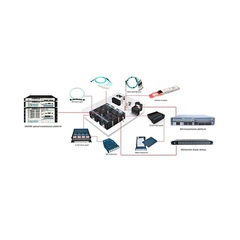
The multi-span OADM transport network allows for the addition of nodes to a single fiber without redesigns or significant current network changes, supports up to 40 x 10G rates, and supports 10GE, STM64, fc-16 and other transport requirements. Next, I will show you the solution of the OADM transport network for DWDM devices.
HTF DWDM devices provide flexible, high-density network solutions for long-distance DWDM networks. All DWDM devices have a high level of protection to ensure good transmission performance and are designed to provide you with ideal solutions.