




WDM and DWDM are names for WDM system in different development stages. In the early 1980s, people thought of and first adopted a WDM system that transmits 1 channel of optical wavelength signals in two low-loss Windows of fiber (1310nm and 1550nm respectively), namely 1310nm and 1550nm two-wavelength division.
With the commercialization of 1550nm window EDFA, the adjacent wavelength interval of WDM system becomes very narrow (generally less than 1.6nm), and it works in a window and shares EDFA optical amplifier. In order to distinguish the WDM system from the traditional WDM system, the WDM system with more closely spaced wavelength intervals is called the dense wavelength division multiplexing system. Density refers to adjacent wavelength intervals.
In the past, WDM systems used to have wavelength intervals of tens of nanometers, but now the wavelength intervals are only 0.4 ~ 2nm. Dense wavelength division multiplexing (DWDM) is a specific form of WDM. The WDM system that people talk about is DWDM system, if it does not specifically refer to the WDM system of 1310nm and 1550nm.
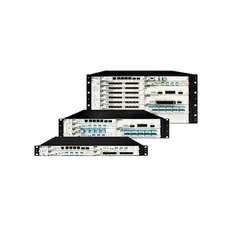
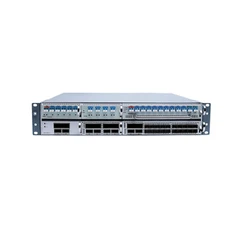
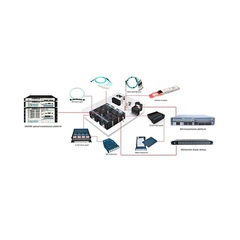
There are many kinds of equipment to realize optical wavelength division multiplexing and transmission, and each functional module has a variety of implementation methods. In general, there are six modules in DWDM system, including optical transmission/receiver, wavelength division multiplexer, optical amplifier, optical dispersion compensator, optical monitoring channel and optical fiber.
The nonlinear effect of fiber is the main factor affecting the performance of WDM transmission system. The nonlinear effect of optical fiber is closely related to optical power density, channel spacing and dispersion of optical fiber. The higher the optical power density and the smaller the channel spacing, the more serious the nonlinear effect is. The relationship between dispersion and various nonlinear effects is complex and the four-wave mixing increases significantly as the dispersion approaches zero. With the continuous development of WDM technology, there are more and more channels transmitted in optical fiber, with smaller and smaller channel spacing and larger and larger transmission power. Therefore, the nonlinear effect of optical fiber has a greater and greater impact on the performance of DWDM transmission system.
The main method to overcome the nonlinear effect is to improve the performance of optical fiber, such as increasing the effective transmission area of optical fiber to reduce the optical power density. A certain amount of dispersion is reserved in the working band to reduce the four-wave mixing effect. The dispersion slope of optical fiber is reduced to expand the working wavelength range of DWDM system and increase the wavelength interval. At the same time, the polarization mode dispersion of the fiber should be reduced as much as possible, and the dispersion of the working band of the fiber should be reduced as much as possible on the basis of reducing the four-wave mixing effect, so as to adapt to the continuous increase of single channel rate.
The light source in DWDM reuse system shall have the following four requirements:
(1) very wide wavelength range;
(2) as many channels as possible;
(3) the spectral width of each channel wavelength should be as narrow as possible;
(4) each channel wavelength and its interval should be highly stable.
Therefore, almost all laser sources used in wavelength division multiplexing systems are distributed feedback lasers (dfb-ld), and most of them are quantum well DFB lasers.
With the development and progress of science and technology, there are two kinds of light sources in WDM system besides discrete dfb-ld, tunable laser and surface emission laser. One is the array of laser diodes, or the integration of laser array and electronic devices, which is actually photoelectric integrated circuit (OEIC). Compared with discrete dfb-ld, this kind of laser has made a big step forward in technology. It is small in size, low in power consumption, high in reliability, and simple and convenient in application. Another new kind of light source -- super continuous light source. It is definitely a Spectrum Sliced SupercontinuumSource. It is shown that when a short pulse with a very high peak power is injected into an optical fiber, the nonlinear propagation will produce a super-continuous (SC) wide spectrum in the fiber, which can be limited to many wavelengths and is suitable for wavelength division multiplexing.