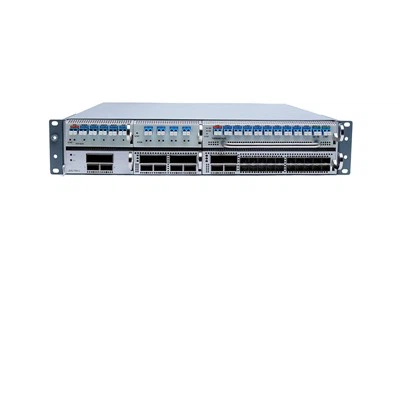





There are two different distribution modes of optical splitter in FTTH network: centralized distribution and cascaded distribution, which correspond to the first level and the second level respectively. These two methods have their own advantages and disadvantages.
What is PON?
PON is a typical passive optical fiber network, which means that ODN is composed of splitter and other passive components without any electronic components and power supply. A passive optical network includes an OLT installed in the central control station and a batch of onus installed in the user's site.
PON technology is a point to multipoint optical access technology, which is composed of OLT at office side, ONU at user side and ODN. The so-called "passive" refers to the ODN does not contain any active electronic devices and electronic power supply, all by optical splitter and other passive components.
PON is a kind of pure dielectric network, which avoids the electromagnetic interference and lightning impact of external equipment, reduces the failure rate of lines and external equipment, improves the system reliability, and saves the maintenance cost. It is a long-term technology expected by the communication industry. Compared with the active system, PON has the advantages of saving optical cable resources, bandwidth resource sharing, saving machine room investment, high equipment security, fast network construction speed and low comprehensive network construction cost.
On the first order spectroscopy
The primary splitter means that the optical splitter between OLT and ONU is parallel, and its basic form is "OLT → optical splitter → ONU". The splitting ratio of the optical splitter used here is usually 1:64. In the application of primary splitter, the optical splitter can be installed in the central office, but in order to save the cost of optical fiber, the optical splitter is usually installed between OLT and ONU. The central office end and the optical splitter are connected through the trunk optical cable, and the user terminal and the optical splitter are connected through the distribution optical cable. Among them, general outdoor optical cable is generally selected for trunk optical cable, and the number of fiber cores varies from 12 to 144; the distribution optical cable should be selected according to the specific application environment, and general outdoor optical cable is generally selected. For some occasions, flame retardant optical cable may be selected.
On the second-order spectroscopy
Two stage splitter means that the optical splitter between OLT and ONU is cascaded, and its basic form is "OLT → optical splitter 1 → optical splitter 2 → ONU". The splitting ratio of optical splitter 1 is usually 1:4 or 1:8, and that of optical splitter 2 is usually 1:8 or 1:16. In the application of two-stage optical splitter, the first stage optical splitter is often installed in the optical junction box or fiber splitter box, and the second stage optical splitter is often installed in the residential area near the end user.
OLT:optical line terminal,terminal equipment for connecting optical fiber trunk lines.
ONU: optical network unit, ONU is divided into active optical network unit and passive optical network unit. Generally, the equipment with network monitoring including optical receiver, uplink optical transmitter and multiple bridge amplifiers is called optical node. The PON uses a single fiber to connect to the OLT, which then connects to the ONU.
What is the difference between OLT, ONU and PON?
OLT is used to connect the terminal equipment of optical fiber trunk; ONU has two functions: to selectively receive the broadcast sent by OLT, to receive the response to OLT if it needs to receive the data; to collect and cache the Ethernet data that users need to send, and to send the cache data to OLT according to the assigned sending window. EPON has the characteristics of saving fiber resources and being transparent to network protocols. EPON uses a single fiber to connect to OLT, and then OLT connects to ONU.
The connection among OLT, ONU and PON is as follows
OLT and ONU are both part of PON architecture. OLT is an optical line terminal, which is an office terminal equipment of telecommunication. It is generally directly connected under bras. ONU is an optical network unit. Under one OLT, multiple onus can be hung through a splitter. When the ONU is put in the user's home, it is FTTH, and when it is put in the building, it is FTTB. ONU is a device, PON is a technology or architecture.
Choose PLC optical splitter or FBT optical splitter?
Before we begin to discuss the construction of FTTH optical splitter, it is necessary to understand the different optical splitter. At present, there are two kinds of common optical splitter: PLC optical splitter and FBT optical splitter.
PLC splitter is a kind of integrated waveguide optical power distribution device based on quartz substrate. Like coaxial cable transmission system, optical network system also needs to couple, branch and distribute optical signal, which needs optical splitter to realize.
PLC splitter is one of the most important passive components in optical fiber link. It is an optical fiber tandem device with multiple inputs and outputs. It is especially suitable for connecting office and terminal equipment in passive optical network (EPON, GPON, BPON, etc.) and realizing optical signal branching.
Parameter characteristics of PLC splitter
1. The loss is insensitive to the wavelength of light, which can meet the transmission needs of different wavelengths;
2. The signal can be evenly distributed to users;
3. Compact structure, small size, can be directly installed in the existing various transfer box, without leaving a lot of installation space;
4. Single device has many channels;
5. The cost of multi-channel is low, and the more the number of branches, the more obvious the cost advantage.
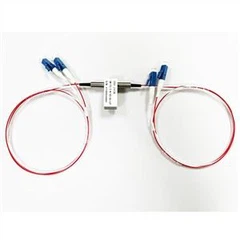
FBT optical splitter is to bundle two or more optical fibers together, then melt and stretch them on the taper machine, and monitor the change of the splitting ratio in real time. When the splitting ratio meets the requirements, the melt and stretch ends. One end of the fiber (the rest is cut off) is reserved as the input end, and the other end is used as the multi-channel output end. At present, the mature taper drawing technology can only pull less than 1 × 4 at a time. If the device is more than 1 × 4, multiple 1 × 2 devices are connected together. And then the whole package is in the splitter box.
The following table compares the differences between the two kinds of optical splitter
Parameter | PLC Small | FBT optical Splitter |
Wavelength range | Optical Splitter | Single / double / triple window |
Spectroscopic Ratio | 1260-1650 nm | Average or uneven distribution |
Volume | Average Distribution | The volume of multi-channel light splitting is large |
Wavelength Sensitivity | Low | High |
Price | Higher | Lower |
FTTH based on PON technology is the development trend of access network in the future. We should choose the splitting mode according to the actual situation, which can save the cost and meet the future demand.
HTF's products quality is guaranteed, and the accessories are imported.
Contact: support@htfuture.com
Skype :sales5_ 1909,WeChat :16635025029