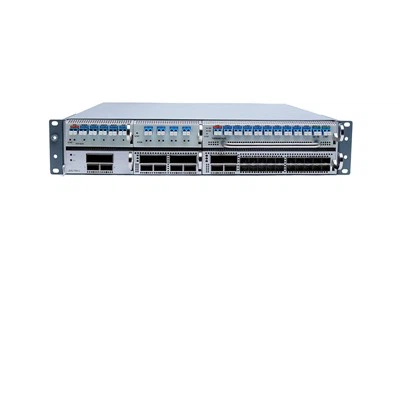





25G Ethernet can make up for the insufficient bandwidth of 10G Ethernet and the high cost of 40G Ethernet.
Overall, it has the following advantages. 25G SerDes has fewer channels, saving fiber resources SerDes is the abbreviation of serializer and deserializer.
It is a mainstream time multiplexing, point-to-point serial technology. Multiple low-speed parallel signals are converted into high-speed serial signals at the transmitting end, and high-speed serial at the receiving end The signal is converted into a low-speed signal.
At present, the rate of SerDes can reach 25Gbps, so only one 25Gbps SerDes channel is needed to achieve 25G connection, while 40G connection requires 4 10Gbps SerDes channels to achieve. The connection between two 40G will have 4 pairs of fibers, which consumes Fiber resources. 25G network card is used for PCle channel utilization rate higher At present, mainstream Intel Xeon CPUs only provide 40 channels of PCle (PCle 3.0), with a single channel bandwidth of about 8Gbps.
These channels are not only used for communication between the CPU and network card, but also used for RAID cards, GPU cards and all other peripherals. For communication between cards, it is necessary to improve the utilization of the network card to the limited PCle channel.
A single 40G network card requires at least PCle 3.0*8 channels, then the actual channel bandwidth utilization rate for both ends running at the same time is 40G*2/(8G*16)=62.5%, and the 25G network card only needs one PCle*8 channel, then the utilization rate It is 25*2/(8G*8)=78%.
Obviously in terms of PCle channel, 25G is more efficient and flexible than 40G. 25G network cabling cost is low The 40G network uses QSFP+ optical modules and MTP/MPO fiber jumpers to connect, and this wiring scheme is not compatible with 10G networks.
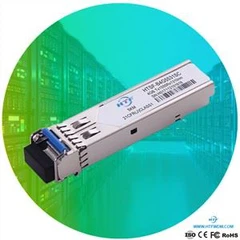
If you upgrade from 10G to 40G, you need to re-wiring, which is costly and wastes resources. In contrast, the SFP28 optical module used in the 25G network can operate with the LC jumper of the 10G network. If you upgrade from 10G to 25G, you can avoid redundant wiring, which saves time and money. 25G's advantages for switch I/O (input and output) First, 25G Ethernet has excellent switch I/O performance and structural capabilities. Its rate is 2.5 times that of 10G, which can increase switch port density and scalability.
Second, compared with 40G, it reduces switches, power supplies, heat dissipation, and wiring. The number of equipment can reduce capital expenditures and operating expenditures; in addition, the 25G standard is established on the 100G standard, and 100G can be realized through 4 25Gbps channels, reducing switch costs.