




The OSFP is a new pluggable form factor with eight high speed electrical lanes that will initially support 400Gb/s (8x50G). It is slightly wider and deeper than the QSFP but it still supports 36 OSFP ports per 1U front panel, enabling 14.4Tb/s per 1U.
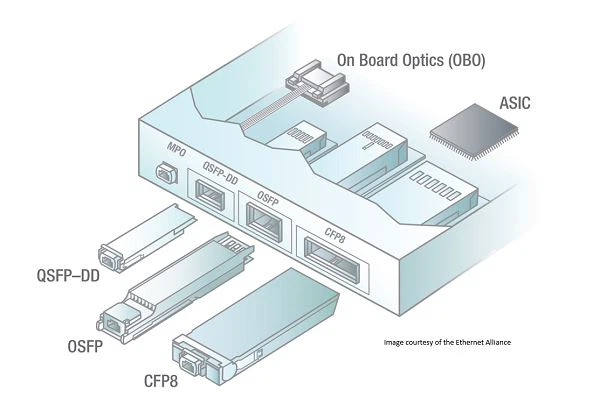
Tips: In the latest release of OSFP MSA, OSFP already supports 800Gb/s, which may be the reason why OSFP is also one of the popular 400G form-factors.
Size — According to the previous introduction, OSFP seems to have little difference from QSFP-DD, just "slightly wider and longer" than QSFP-DD. However, after comparing their specific size values, we found that the difference is not just a little bit. The width, length and thickness of QSFP-DD are 18.35mm, 89.4mm and 8.5mm, while those of OSFP are 22.58mm, 107.8mm and 13.0mm. If the module is roughly calculated as a cuboid, the volume of the OSFP could be more than twice that of QSFP-DD, and it is obvious that the former is much larger.
Thermal Capacity and Power Consumption — The QSFP-DD is smaller in size, so its thermal capacity is only 7 to 12 watts. While the OSFP is larger in size, its thermal capacity can reach 12 to 15 watts. The larger the thermal capacity, the greater the power consumption that the optical module can withstand. However, with the advancement of technology, some industry-leading manufacturers have been able to reduce the power consumption of optical modules far below the upper limit of thermal capacity specified by MSA, so the larger thermal capacity does not seem to be a real advantage in the future. Consistent with the thermal capacity, OSFP's power consumption is generally higher than QSFP-DD. However, as we all know, the lower the power consumption, the better.
Backwards Compatibility — OSFP is as backward compatible with QSFP+/QSFP28 as QSFP-DD, but requires an additional OSFP to QSFP adapter. Since the OSFP is slightly wider and deeper than the QSFP, it is possible to build an adapter that supports existing 100G QSFP optics modules (QSFP28) in a OSFP cage.
Bandwidth — QSFP-DD currently only supports up to 400Gb/s, but OSFP can support up to 800Gb/s. Considering scalability, OSFP is slightly better than QSFP-DD. But 800Gb/s is too early, and when 800Gb/s starts to deploy, there may be better options.
In summary, QSFP-DD is mainly used to apply 400G networks that are currently being deployed (and 200G over 100G to 400G), while OSFP is more likely to be prepared for future 800G networks. Therefore, combined with the status quo, QSFP-DD is more suitable as a form-factor of 400G optical transceivers.