




QSFP-DD, QSFP+, QSFP28 and QSFP56 belong to the QSFP form factor, but what are the differences among them? The differences are explained in the following descriptions.
Structure
In terms of the appearance, the width, length and thickness of the QSFP-DD are the same as QSFP+, QSFP28 and QSFP56. But the QSFP-DD module is equipped with an 8-lane electrical interface rather than a 4-lane like other QSFP modules and the ASIC ports of QSFP-DD are doubled to support existing interfaces such as CAUI-4. Therefore, the mechanical interface of QSFP-DD on the host board is slightly deeper than that of the other QSFP system transceivers to accommodate the extra row of contacts.
Bandwidth & Application
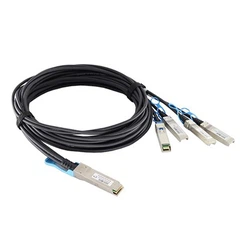
The QSFP-DD modules can support 400Gbps while QSFP+/QSFP28/QSFP56 can only reach 40Gbps/100Gbps/200Gbps respectively. Therefore, QSFP-DD connectors are used in 400G optical modules, DACs and AOCs, and applied for the 400G data center interconnections. And QSFP+/QSFP28/QSFP56 modules and DAC/AOC are used for 40G/100G/200G networks. interconnection.
Backward Compatibility
As mentioned above, the QSFP-DD can be backward compatible with the previous QSFP system transceiver modules. In other words, based on the previous form factor, the QSFP-DD has been technically upgraded to support increased bandwidth. And its backward compatibility can avoid existing equipment replacement on the scale and effectively reduce the network upgrade cost.
| Form Factor | QSFP-DD | QSFP56 | QSFP28 | QSFP+ |
|---|---|---|---|---|
| Released Year | 2016 | 2018 | 2016 | 2010 |
| Number of Electrical Interface Lanes | 8 | 4 | 4 | 4 |
| Single Channel Rate | 25Gbps/50Gbps | 50Gbps | 25Gbps | 10Gbps |
| Modulation Technology | NRZ/PAM4 | PAM4 | NRZ | NRZ |
| Backward Compatibility | QSFP+/QSFP28/QSFP56 | QSFP+/QSFP28 | QSFP+ | / |
QSFP-DD vs OSFP/CFP8/COBO
QSFP-DD (QSFP56-DD) and OSFP/CFP8/COBO are the form factors of 400G optics on the market, the differences of them are listed below:
QSFP-DD vs OSFP
QSFP is a new pluggable form factor with eight high speed electrical lanes that will initially support 400Gb/s (8x50G) or reach up to 800Gb/s. The width, length and thickness of QSFP-DD are 18.35mm, 89.4mm and 8.5mm, while those of OSFP are 22.58mm, 107.8mm and 13.0mm. It is obvious that the OSFP form factor is slightly wider and deeper than the QSFP-DD, but it still supports 36 OSFP ports per 1U front panel, enabling 14.4Tb/s per 1U.
Generally, the power consumption of QSFP-DD is 7-12W, while the OSFP can reach 12-15W. The lower the power consumption, the better the performance of the transceiver. Unlike the QSFP-DD, OSFP can’t be backward compatible with QSFP+/QSFP28 since it has a larger size than that of QSFP+/QSFP28.
QSFP-DD vs CFP8
Featuring a 41.5mm*107.5mm*9.5mm form factor, the CFP8 module delivers four times more bandwidth than existing 100G solutions. Its electrical interface has been generally specified to allow for 16x25 Gb/s and 8x50 Gb/s mode. Since the size of CFP8 is almost three times larger than that of QSFP-DD, the power consumption of CFP8 is much higher than QSFP-DD. Meanwhile, the CFP8 can’t be used on QSFP+/QSFP28 ports. The maximum bandwidth of CFP8 and QSFP-DD is 400Gb/s, but CFP8 only supports in the form of 16x25G or 8x50G while QSFP-DD also supports both 200Gb/s (8x25G).
QSFP-DD vs COBO
COBO stands for Consortium for On-Board Optics, it can be installed internally to the line-card equipment in a controlled environment, which lacks flexibility. And it doesn’t support hot-pluggable, so it is more difficult for COBO modules to maintain than QSFP-DD. Additionally, the COBO form factor has two electrical interfaces——one eight lane and the other sixteen lane to meet both 1x400G and 2x400G transmission requirements.
The following chart shows the market maturity of the QSFP-DD, OSFP, CFP8 and COBO form factors. The larger the numbers, the higher the market maturity of these form factors.
| Performance | CFP8 | OSFP | QSFP-DD | COBO |
|---|---|---|---|---|
| Volume | 1 | 2 | 3 | 4 |
| Power Consumption | 3 | 2 | 1 | 4 |
| Cost | 1 | 3 | 4 | 2 |
| Maturity | 4 | 3 | 2 | 1 |
| Compatibility | 3 | 2 | 4 | 1 |
| Difficulty for Operation & Maintenance | 2 | 3 | 4 | 1 |
| Overall Ratings | 14 | 15 | 18 | 13 |
We can see from the table that the overall rating of QSFP-DD and OSFP form factors are higher than other form factors. So the QSFP-DD and OSFP are more popular with fiber optic manufacturers. While the former is suitable for data center applications and the latter often applied for telecommunications applications.