


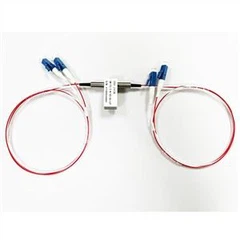
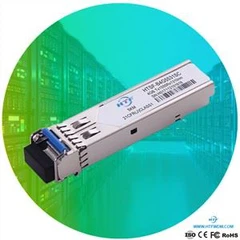


Internal structure of optical module
Transmitter and receiver are optical transceivers. The most important one is laser, and there are also detectors and amplifiers. Laser is the core of optical module, and it is also the most cost-effective and high-tech thing. Generally speaking, the higher the high-end optical module products, the higher the proportion of lasers in the cost structure. In addition, there are filters, gold fingers, PCB circuit boards and capacitors, resistors, inductors, EEPROM, structural parts and hidden solder, glue and so on.
Why is the technology threshold of optical module / AOC / DAC low?
Because of some high-end products, there are few manufacturers in the world, such as 400g optical module. In addition, for the same products, such as 100g single-mode, when most manufacturers can only achieve more than 10 kilometers, a few manufacturers can already achieve 40 kilometers. But for the vast majority of mature products, the threshold in this field is really too low.
The reason for the low threshold is that the optical module / AOC / DAC can basically be regarded as a pure hardware product. Although the MCU controller also runs the driver, it is relatively simple and standard. For module manufacturers, the core devices used in this hardware product are highly similar in technical solutions for many mature products, and there are not too many thresholds. This is very different from the switch. Although all switch manufacturers can get the same CPU and switch chip without quality difference, the differences in overall board design and complex software system lead to great differences in overall quality and capability.
What's the difference?
The compatibility problems between different modules and different devices are very strange. Even the modules of the same manufacturer and the same model will have differences on the same equipment. In brief, it is the difference between engineering quality and supply quality.
The quality of PCB, the quality of capacitor resistor, the length, width and thickness of gold finger, the quality of solder and even the quality of glue all affect the quality of the product. For example, the voltage and current jitter, and the temperature rise will cause problems.
Different coupling processes, such as cob coupling mode and SMD coupling mode, have different choices from each manufacturer. Even different products of the same manufacturer have different choices. They will lead to differences in cost, heat dissipation and high temperature resistance.
The difference of production test equipment, the number of equipment, the variety richness, the degree of automation, the richness of switch / server network card and other third-party equipment will lead to the difference of yield and compatibility.
What really reflects the differences in technical capabilities of manufacturers is generally in high-end products, such as 100g / 400g modules, especially long-distance ones. For general new products, large manufacturers will invest in equipment and R & D in advance to accumulate technical advantages in advance. In the case of limited production capacity, upstream manufacturers will also give priority to providing chips and lasers to large manufacturers, so large manufacturers usually lead small manufacturers in new products for at least one year.

What is the difference between AOC and optical module?
AOC (active optical cable) is a module attached to both ends of an optical fiber, which is equivalent to the integration of wire and module.
AOC is now widely used by many customers because it is cheaper than two modules plus one fiber.
From a technical point of view, like optical modules, AOC is still driven by light, and the core devices in it cannot be less. The main difference between them is the difficulty of technology. For the optical module, in the internal device coupling, because the opposite end situation may be very different, so it needs to adapt to different conditions, high requirements for laser and high complexity of manual operation. AOC, because the opposite end is fixed, does not need to consider various situations. It has low requirements for lasers, relatively simple peripheral components and simple manual operation, which can reduce some costs. This is why the price of AOC is lower than that of two modules + one fiber.
Although the cost of AOC is lower, compared with optical module, AOC also has defects. For example, in AOC cable, if there is a problem with one module or optical fiber, it needs to be replaced completely, while the optical module is not required. Especially in some environments where the wiring has been completed, it is a very troublesome thing to pull out the AOC cable. In addition, if the equipment at both ends are of different manufacturers, the modules of different manufacturers can be purchased separately to avoid compatibility If the AOC solution is used, the AOC supplier can only write the code in advance. It may even be necessary to mark the AOC cable and which end corresponds to which manufacturer.

What is the difference between DAC and AOC?
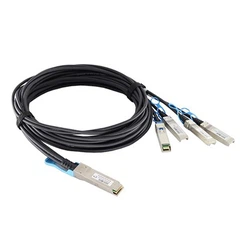
DAC (direct attach cable) is a module at both ends, and the wire in the middle is not optical fiber, but copper cable.
AOC is called active optical cable, while DAC is divided into active and passive, and the mainstream is passive. Some manufacturers add a signal amplifier chip, which is the active copper cable, in order to let DAC transmit farther.
Strictly speaking, DAC does not belong to the category of optical modules. There are no lasers, amplifiers, detectors, or MCU controllers as complicated as optical modules. In other words, DAC, the most expensive key device in optical module / AOC, has no DAC. There is only a simple control chip for electrical signals, which is transmitted from beginning to end. This is why the price of DAC is much lower than that of optical module and AOC.
We know that when the optical module or AOC is plugged into the switch interface, the voltage, current, temperature, received optical power and transmitted optical power of the optical module can be seen with the command on the switch. But if the inserted DAC usually can't read this information, why? The reason is that there is a DDM storage area in the optical module and AOC to store the information. In the DAC, on the one hand, because it does not have the concept of receiving and transmitting optical power, on the other hand, there is no strong MCU chip, so it can not detect temperature, voltage and current, so DAC usually has no DDM information.
Because the DAC is purely driven by electricity, the distance is generally not far, because the electric signal is more easily limited by the distance than the optical signal (poor anti-interference ability), generally within 5m, unless the active cable is added with an amplifier. Compared with optical, electrical signals are more easily disturbed by distance, temperature, radiation, cable folding and other issues, so DAC is more prone to compatibility problems than AOC, which depends on the driving ability of devices at both ends. But for AOC, its main problem is that the fiber is easy to break, of course, many of the current ray folding resistance is good. Therefore, in general, if the use environment is controllable, the distance is not long, price sensitive, and compatibility issues can be eliminated in advance, DAC is a good choice.
What is the code writing encryption of optical module / AOC / DAC?
Strictly speaking, the compatibility problem we usually talk about is not the same thing as the code writing encryption. The compatibility problem refers to the problems mentioned above, because there are differences in the implementation of the standards, resulting in mismatching when working together, which is not intentional. However, the module cannot work on the device due to code writing encryption, which is intentional.
According to the definition in the industry standard specification of optical module, there are two areas of 128 byte code writing area in the optical module. These two code writing areas store many information such as manufacturer, model, serial number, DDM information (allowable voltage, current, temperature, luminous power range and actually collected values) and compatibility code. Many equipment manufacturers have made restrictions in the switch and other network equipment. After the optical module is inserted, it will read the information of the code writing area in the optical module through the I2C bus of the switch. Through this information, the equipment can determine whether the module is its own original module.
Coder
There are industry standards for the code writing area in the optical module (different kinds of optical module standards are different), and the direct interface between equipment (switch, router, network card, etc.) and optical module is also standard (I2C standard). Therefore, theoretically, it is very easy to make a coder, and the coder is a necessary product for module manufacturers. What many people don't know is that the switch manufacturer can also use the switch as a code writer, and can write code in batch, because the standard I2C interface is also between the switch and the optical module. In theory, the coder can write the optical module of manufacturer a into the code of manufacturer B. in order to prevent others from writing their own modules, the module manufacturers have set up password protection. You do not know the password. After writing, once the device is restarted or the module is re inserted, the written code will be lost.
contact:support@htfuture.com
Skype:sales5_ 1909,WeChat:1663502502