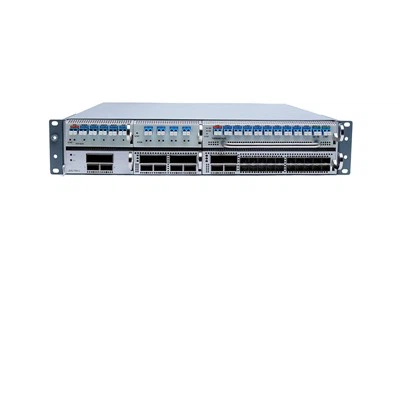





This article will introduce some common Ethernet switch port types from three aspects of transmission rate, function and network architecture to help you better understand the differences between them and prepare for future network deployment.
The port types of Ethernet switch are divided according to different transmission rates
Transmission rate is a crucial factor to determine the type of Ethernet switch port. At present, the transmission rate of Ethernet switch is 1G / 10G / 25G / 40G / 100G or even higher. The following are the main port types of simultaneous interpreting Ethernet switches.
RJ45 port
At present, the port on 1000BASE-T Ethernet switch is RJ45. This type of port can be used for server access in data center, LAN, uplink of desktop switch or Gigabit to desktop bandwidth application. When two 1000BASE-T Ethernet switches are connected, standard twisted pair cables are usually used, such as cat 5, super cat 5, cat 6 and super cat 6 network jumpers.
SFP port
The SFP port (Mini GBIC port) is a small hot swap interface. In Ethernet, the speed of SFPs is 1GBIT / s, and in fibre channel system, the speed of SFPs is 4GBIT / s. When the optical module of SFP is inserted into the Gigabit switch with SFP port and used with different cables (optical fiber jumper or copper cable), the long-distance transmission can be realized on the optical fiber and the short-distance transmission can be realized on the copper cable. For example, when using SFP1G -55 optical module and LC duplex optical fiber jumper connection, the maximum transmission distance is 160 km, and when using SFP-GB-GE-T optical module (i.e. electrical interface module) and class V network cable connection, the maximum transmission distance is 100 m.
SFP + port
The SFP + port (small pluggable interface) is an upgraded version of the SFP port, which can support up to 10Gbps transmission rate. The SFP + port has backward compatibility, that is to say, the SFP + port can support the SFP optical module, but the transmission rate of the link will be reduced to 1Gbps. It should be noted that the SFP + optical module cannot be supported on the SFP port because the speed of the SFP + optical module cannot be adjusted to 1Gbps.
SFP28 port
The SFP28 port is an upgrade of the SFP +, both of which have the same shape and size, but the SFP28 can achieve 25Gb / s transmission rate on a single channel. The emergence of SFP28 provides a new path for data center network upgrade -- 10G-25G-100G network upgrade path. Compared with the previous 10G-40G-100G network upgrade path, 10G-25G-100G is a more cost-effective solution, which can meet the growing demand of the next generation data center network bandwidth.
QSFP + port
QSFP + port is developed on the basis of QSFP (four channel small pluggable interface). It has 4x10G channels and is suitable for 40G Ethernet. In other words, the QSFP + port is equivalent to 40 Gbps transmission through four channel SFP + interfaces.
QSFP28 port
QSFP28 port is specially designed for 100G applications. It has four high-speed differential signal channels, supports data transmission rates from 25Gbps to 40Gbps, and meets the requirements of 100Gbps (4x25Gbps) Ethernet and 100Gbps 4x Infiniband enhanced data rate (EDR).
According to different functions, the port types of Ethernet switches are divided
Combo port
Combo port refers to the two Ethernet ports on the switch panel, i.e. electric port (RJ45 port) and optical port (SFP port). In short, a combo port is actually a composite port, which can support two different physical ports and share the same switch fabric and port number. However, these two different physical ports cannot be used at the same time, which means that if you are using the SFP port, the corresponding RJ45 port will be automatically disabled, and vice versa. In general, the biggest advantage of combo port is to provide different types of connections without occupying unused switch fabric, so as to provide users with powerful functions and flexibility. The switch can be configured according to special network application requirements.
stack port
Stack port is a special function port of Ethernet switch, which is mainly used for stack connection with Ethernet switches of the same brand, model and software version. Multiple stack switches can be regarded as one switch, and users can manage all switches in the stack through the main switch in the stack. At the same time, the port capacity after stacking is the sum of all stacked switch ports. In addition, the stack port can be an uplink port in an Ethernet switch or a port dedicated to stacking.
Ethernet power supply port
Ethernet power supply port (POE port) can transmit data and power simultaneously through twisted pair. At present, the port of Ethernet switch (POE switch) following IEEE 802.3af standard can provide up to 15.4W power supply; the port of Ethernet switch (POE + switch) following IEEE 802.3at standard can provide up to 30W power supply. However, with the increase of distance, the power will be attenuated, so the minimum power available on the power supply equipment of Poe switch is 12.9w; the minimum power available on the power supply equipment of Poe + switch is 25.5w.
According to the different network architecture, Ethernet switch port types are divided
The traditional network architecture (three-layer network architecture) usually includes the core layer, convergence layer and access layer. Accordingly, the ports of Ethernet switch can also be divided in this way.
Access port
The access port is mainly used to connect desktop computers, laptops, printers and other devices, only the access link. Generally, the access port can only belong to one VLAN (that is, the access port can only be a member of this particular VLAN), and only transmits data frames for this VLAN. All data frames not classified as this VLAN will be discarded. Among them, the interface port will only send and receive data frames in native format, and will not carry out VLAN tagging, that is to say, data frames will not carry any VLAN tags.
Trunk port
Relay port refers to the connection port between switches or between switches and routers or between switches and servers, which can be used to connect relay links. The relay port allows multiple VLANs to pass through, and can receive and send messages from multiple VLANs at the same time. The relay port is the VLAN aggregation port connected to other switch ports, and the access port is the port that the switch connects to the host in the VLAN.
Hybrid port
Hybrid port refers to the connection port used to connect network equipment and user equipment, and the port used to connect hybrid link. Mixed ports can support both unlabeled VLANs (such as access ports) and tagged VLANs (such as relay ports). The same as the relay port, the hybrid port can also allow multiple VLANs to pass through, and can receive and send messages from multiple VLANs. However, the difference is that the hybrid port can allow multiple VLAN messages to be sent without labels, while the relay port only allows messages from the default VLAN to be sent without labels. Although there are many similarities between hybrid port and relay port, hybrid port has more port configuration functions.
If you can distinguish the different types of Ethernet switch ports, it will help you choose the Ethernet switch that is more suitable for your own network. In addition, when considering the type and number of ports required, we should also consider the current and future traffic volume and functional requirements. The most important thing is what suits you.
HTF's products quality is guaranteed, and the accessories are imported.
Contact: support@htfuture.com
Skype :sales5_ 1909,WeChat :16635025029