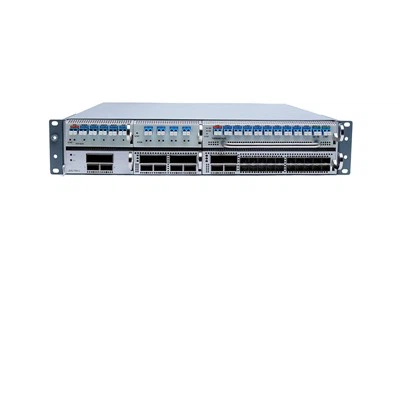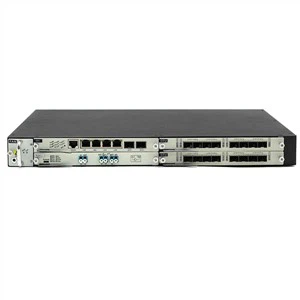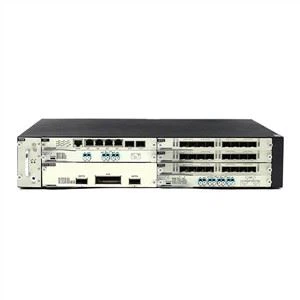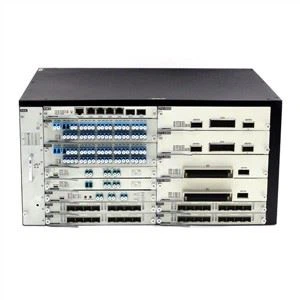



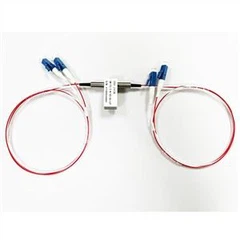
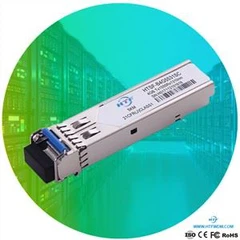


Products are generally used in the actual network environment where Ethernet cable cannot be covered and optical fiber must be used to extend the transmission distance, and it is usually located in the access layer application of broadband man; for example, HD video image transmission of monitoring security engineering; at the same time, it also plays a huge role in helping to connect the last kilometer of optical fiber line to man and the outer network.
The HTF-G201SFP Gigabit SFP Media Converter provides 1 TP and 2 SFP ports to support conversion between 10/100/1000Base-T and 100/1000Base-X network. With the two 100Base-FX or 1000Base-SX / LX SFP ports, the HTF-G201SFP provides high reliability and flexibility to extend the media transmission distance up to 550m, 20km, or longer depending on the SFP fiber modules. It allows the two types of segment to connect easily, efficiently and inexpensively.

Product features
● Support 1 10 / 100 / 1000m adaptive electrical port and 1 gigabit optical port (single fiber /
dual fiber optional)
● Automatic negotiation of half duplex or full duplex
● The multi-mode transmission distance can reach 550 meters, and the maximum single-mode
transmission distance can reach 80 kilometers
● It has the functions of broadcast storm protection, traffic balance, conflict isolation and error
detection
● High performance switch chip and large capacity cache are adopted
● High quality laser devices have good optical, electrical and temperature stability
● Scientific circuit layout, strong anti-interference ability, can effectively prevent lightning strike
● The working state indicator light is complete and the working state is clear at a glance
● External professional switching power supply, safe and stable, power consumption less than 5W
● Built in lightning protection circuit can greatly reduce the damage caused by lightning induction
Specifications
Parameter | Specifications |
Access mode | 10/100/1000Mbps Gigabit Ethernet |
Standard | IEEE802.3 10Base-T Ethernet, IEEE802.3u 100Base-TX 100Base-FX Fast Ethernet, IEEE802.3ab 1000Base-T, IEEE802.3z 1000Base-SX/LX Gigabit Ethernet, IEEE802.3x flow control |
Wavelength | Vary on SFP fiber module |
Transmission distance | SFP port: Vary on SFP fiber module Category-5 twisted pairs: 100m |
Port | One RJ45 port: Connecting with STP/UTP category-5 twisted pairs, EIA568A/B Two SFP port slots: Vary on SFP fiber module |
BER | <10-9 |
MTBF | 100,000 hours |
Switch mechanism | Store-and-Forward |
LED indicator | POWER (power supply), TP Speed (On:1000Mbps,Off:10/100Mbps) TP LINK/ACT , SD1(SFP Port 1 link/act LED), SD2(SFP Port 2 link/act LED) |
Power supply | External: AC90~264V/DC100~380V input, 5V 2A output |
Power consumption | Max. 5W |
Operating temperature | -10~55ºC |
Operating humidity | 5%~90% |
Maintaining temperature | -40~70ºC |
Maintaining humidity | 5% ~ 90% non-condensing |
Dimensions | 71mm (W)×94mm (D)×26 mm (H) (external power supply) |
Classification


Work style classification
Full duplex means that when the sending and receiving of data are shunted and transmitted by two different transmission lines, both sides of the communication can send and receive at the same time. This transmission mode is full duplex system, as shown in Figure 1. In full duplex mode, the transmitter and receiver are set at each end of the communication system, so that the data can be transmitted in two directions at the same time. The full duplex mode does not need to switch the direction, so there is no time delay caused by the switching operation.
Half duplex refers to the use of the same transmission line for both receiving and sending. Although data can be transmitted in two directions, both sides of the communication can not receive and receive data at the same time. This transmission mode is half duplex system. When half duplex mode is adopted, the transmitter and receiver at each end of the communication system are transferred to the communication line through the receive / transmit switch to switch the direction. Therefore, there will be time delay.
Optical fiber transceiver is generally used in the actual network environment where Ethernet cable cannot be covered and optical fiber must be used to extend the transmission distance. At the same time, it also plays a great role in helping to connect the last kilometer line of optical fiber to man and the outer network. With optical fiber transceiver, it also provides a low-cost solution for users who need to upgrade the system from copper wire to optical fiber. The function of optical fiber transceiver is to convert the electric signal we want to send into optical signal and send it out. At the same time, it can convert the received optical signal into electrical signal and input it to our receiving end.
Matters needing attention
There are many different types of optical fiber transceivers, but in practical use, most of them pay attention to the classification according to the different optical fiber connectors: SC joint optical fiber transceiver and FC / St joint optical fiber transceiver.
When using optical fiber transceiver to connect different devices, we must pay attention to the different ports used.
1. Connection of optical fiber transceiver to 100base-tx equipment (switch, hub)
Confirm that the maximum length of twisted pair shall not exceed 100m;
Connect one end of twisted pair to RJ-45 port of optical fiber transceiver, and the other end to RJ-45 port (common port) of 100base-tx equipment (switch, hub).
2. Connection of optical fiber transceiver to 100base-tx equipment (network card)
Confirm that the maximum length of twisted pair shall not exceed 100m;
Connect one end of twisted pair to RJ-45 port (100base-tx port) of optical fiber transceiver, and the other end to RJ-45 port of network card.
3. Connection of optical fiber transceiver to 100Base-FX:
Confirm that the optical fiber length does not exceed the distance range provided by the equipment;
One end of optical fiber is connected with SC / FC / St connector of optical fiber transceiver, and the other end is connected with SC / St connector of 100Base-FX equipment.
In addition, it needs to be added that many users think that the fiber can be used normally as long as the length of the fiber is within the maximum distance that the single-mode fiber or multimode fiber can support. In fact, this is a wrong understanding. This understanding is correct only when the connected devices are full duplex devices. When there are half duplex devices, the transmission distance of optical fiber is limited.
HTF 'products have a complete range, long warranty time and reasonable price.
Contact:support@htfuture.com
Skype:sales5_ 1909,WeChat:16635025029