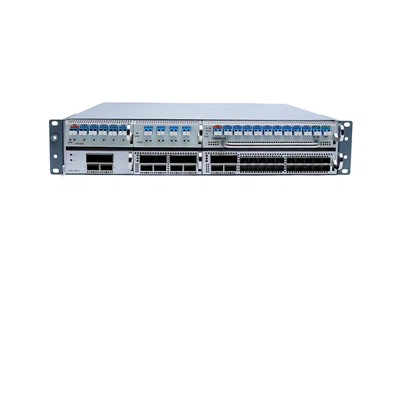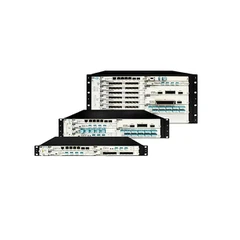
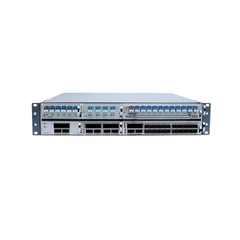

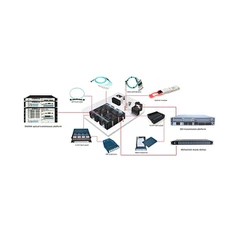


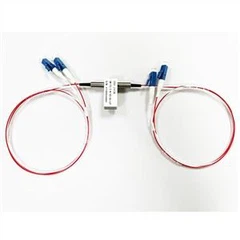


Dispersion Compensation Module (DCM) : In optical fiber communication, dispersion compensation module (DCM) (also called dispersion compensation unit, DCU) can be used to compensate for long-span chromatic dispersion of transmission fibers. Typically, such a module provides a certain amount of dispersion (e.g. normal dispersion in a 1.6-μm spectral region), although tunable dispersion modules are also available.
A module can be easily inserted into a fiber-optic link because it has fiber connectors for input and output. The loss of insertion can be compensated with a fiber amplifier, e.g. An erbium-doped fiber amplifier in a 1.5-micron telecom system. We also often see that a dispersion-compensating module is often placed between two fiber amplifiers.
Dispersion Compensation Module (DCM)
Purpose of Dispersion Compensation Module (DCM)
a. Dispersion is the function of the length of the optical fiber and thus with respect of the length it increases.
b. The purpose of using DCM is that this accumulated dispersion lead to ISI and the loss of the data in the transmission.
c. To overcome this accumulated dispersion and to increase the transmission length we need a module called the Dispersion Compensating Module (DCM).
d. DCM usually consists of optical elements with high negative dispersion coefficient.Due to dispersion the light pulses spread and tend to overlap with the adjoining pulse period. This leads to interference between adjacent bits and results in high BER. At high bit rates for the same pulse width, the BER (due to dispersion) will become excessive.