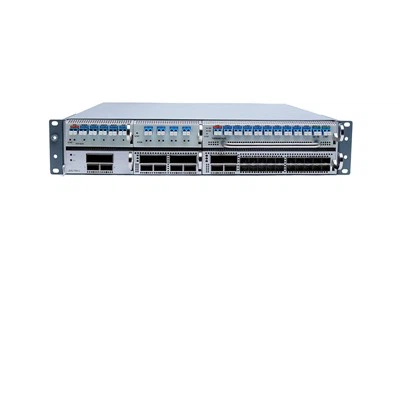



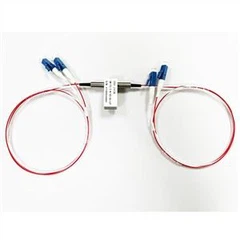


Optical switch is a transmission port with one or more optional transmission ports.
Its function is an optical device that performs mutual conversion or logical operation of optical signals in optical transmission lines or integrated optical circuits.
Optical switches, optical amplification, and optical signal storage are all optical device materials. The optical switch can be operated within picoseconds (10^-12 seconds). At present, it is based on lithium niobate and gallium aluminum arsenic compound, formed from the electronics industry. Some new materials, such as liquid crystal, polyacetylene, etc., have better optical effects than lithium niobate.
Optical switches are classified from the manufacturing process, and can be divided into micro-opto-electromechanical MEMS system switches and non-micro-opto-electromechanical system switches. The former is mainly divided into three sub-categories
Folded fiber type
Electromagnetic drive fiber
There are optical fiber drives that use electromagnetic coils to drive optical fibers. A magnetic film is coated on the optical fiber. When closed, the coil is energized to move the optical fiber. When it is turned on, a permanent magnet is used to attract the optical fiber back
Silicon stage drive fiber
There are switches that use the movement of the silicon stage to select the light path. The guide groove for the slide of the stage and the V-shaped groove for fixing the optical fiber are made by anisotropic etching of single crystal silicon. The traditional technique is to deposit a magnetic film on the stage, and use a permanent magnet to slide it to the target position in order to conduct the light path; now, there is a method of manufacturing a coil pattern by photolithography.
Three-dimensional mirror rotating fiber
There are three-dimensional mirror rotation to turn on or off the optical path of the fiber
Lens drive switch
Use the movement of the lens (movement in the direction perpendicular to the optical axis) to change the direction of the optical path. There is a relationship between the focal length, the amount of movement and the angle of light deviation
Planar waveguide
Folding waveguide drive
In addition to Lorentz force, there is also electrostatic force
Bubble drive: use thermal capillary phenomenon, inkjet method
The way of taking in and out of the micro-mirror; similar to the optical fiber, there are many ways
Folding optical film
MARS, mechanical anti-radiation switch
Grating light valve, GLV
The distance of the diffraction grating can be changed
Folding non-micro-optical electromechanical system switch
Prism drive switch, use the tiny movement of the prism to switch the circuit
EO electro-optical effect switch, switching circuit for changing refractive index by electric field
Application of TO thermo-optic effect and interference: use Mach-Zehnder interference
Switch with plasma effect
MO magneto-optical effect switch: use magnetic field to change the direction of polarized light