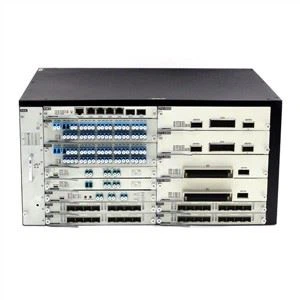

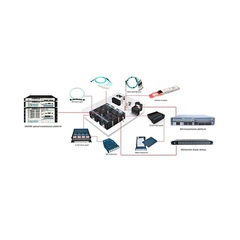




WDM wavelength division multiplexing is a transmission technology that uses a single fiber to simultaneously transmit multiple optical carriers of different wavelengths in optical fiber communications.
When the wavelength of light is different, the transmission loss in the fiber is different. In order to reduce the loss as much as possible and ensure the transmission effect, it is necessary to find the most suitable wavelength for transmission. After a long period of exploration and testing, the light in the wavelength range of 1260nm to 1625nm has the least signal distortion caused by dispersion and the lowest loss. It is most suitable for transmission in optical fiber.
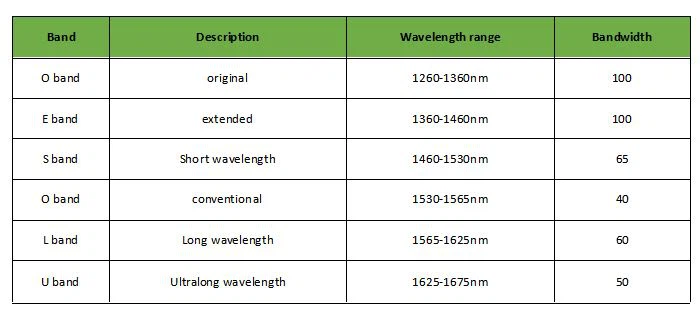
The possible wavelength of the optical fiber is divided into several bands, and each band is used as an independent channel to transmit an optical signal of a predetermined wavelength. ITU-T divides the single-mode fiber in the frequency band above 1260nm into O, E, S, and C , L, U several bands.
The C-band (Conventional Band) ranges from 1530 nm to 1565 nm and represents the conventional band. Optical fiber shows the lowest loss in the C-band, and has a large advantage in long-distance transmission systems. It is usually used in many metropolitan areas combined with WDM, long-distance, ultra-long-distance and submarine optical transmission systems and EDFA technology.
As the transmission distance becomes longer and fiber optic amplifiers are used instead of optical-to-electronic-to-optical repeaters, the C-band becomes more and more important. With the advent of DWDM (Dense Wavelength Division Multiplexing) that allows multiple signals to share a single fiber, the use of the C-band has been expanded.