


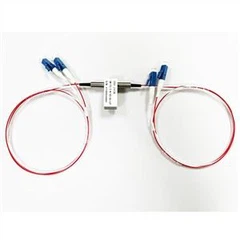
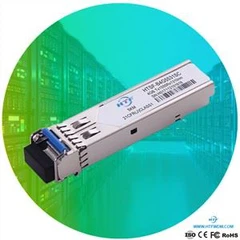


Optical fiber connector is a detachable connection device between optical fiber and optical fiber. It precisely connects the two end faces of optical fiber, so that the optical energy output from transmitting optical fiber can be coupled to the receiving optical fiber to the maximum extent, and the impact on the system caused by its intervention in optical link can be minimized. This is the basic requirement of optical fiber connector.
Several mainstream optical fiber connectors
LC type optical fiber connector: it is a connector for connecting to SFPs. It is a convenient and fast modular jack, which is often used in routers.
FC type optical fiber connector: metal sleeve is used for external reinforcement, and screw buckle is used for fastening. Generally used on ODF side (mostly used on distribution frame)
ST type optical fiber connector: commonly used in optical fiber distribution frame, the shell is round, and the fastening method is screw buckle. For a 10base-f connection, the connector is usually ST type. (commonly used in optical fiber distribution frame)
SC type optical fiber connector: it is a connector connecting GBIC optical module or ordinary optical fiber transceiver. Its shell is rectangular, and the fastening method is plug-in latch type, without rotation. (more used on routers and switches)
Differences among PC, APC and UPC of optical fiber connector
In order to make the end faces of two optical fibers contact better, the insert end faces of optical fiber jumpers are usually ground into different structures. Common grinding methods are: PC, APC, UPC. PC / APC / UPC represents the front face structure of ceramic insert.

PC is physical contact. The surface of PC microsphere is ground and polished, the surface of the insert core is ground into a slight spherical surface, and the fiber core is located at the highest bending point, which can effectively reduce the air gap between the fiber components and make the two fiber ends reach physical contact. The UPC / PC connector is blue.PC fiber connector is a kind of connector polished by physical contact. It is the most common polishing type on OM1 and OM2 multimode fiber. Its butt end face is physical contact, that is, the end face is convex arch structure, and its joint section is flat, which is actually the grinding and polishing of microsphere surface, which is most widely used in the equipment of telecom operators. In the design of PC optical fiber connector, there is a slightly cylindrical conical head, which is used to eliminate the air gap. Therefore, the typical return loss of single-mode optical fiber application is about - 40dB, which is higher than that of the original plane polished style (- 14dB). However, the polishing method of PC connector is out of date, and has been evolving into UPC connector.
APC refers to the angled physical contact, which is called inclined plane physical contact. The end face of optical fiber is usually ground into an 8 ° inclined plane. The 8 ° inclined plane makes the end face of the fiber more compact, and reflects the light to the cladding through its inclined plane angle instead of directly returning to the light source, providing better connection performance. APC connector can only be connected with APC. APC connectors are usually green.
UPC (ultra physical contact). The end face of the UPC connector is not completely flat and has a slight radian to achieve more accurate docking. UPC is based on PC to optimize the end face polishing and surface finish, and the end face looks more dome like.UPC has better surface finish. The return loss of UPC connector is higher than that of PC connector, which is close to - 50dB or higher. It produces a circular finish during the polishing process that allows the fiber to contact a high spot near the fiber core where light travels. In addition, when using the UPC connector, make sure that the laser specifications can handle the return loss generated by the UPC connector. It should be noted that repeated connection and disconnection lead to the quality and performance degradation of UPC connector end face.
Different lapping methods determine the quality of optical fiber transmission, mainly reflected in the return loss and insertion loss.
Insertion loss refers to the signal loss generated by connector or cable. In general, the typical insertion loss of PC, UPC and APC connectors should be less than 0.3dB. Compared with APC connectors, UPC / PC connectors are usually easier to achieve low insertion loss due to smaller air gap. The insertion loss may also be caused by dust particles between the end faces of the connector.
Return loss, also known as reflection loss, is a parameter indicating the reflection performance of a signal. It is usually expressed by a negative dB value, and the higher the value is, the better. The end face of APC connector is bevel polished, so the return loss of APC connector is usually better than that of UPC connector. In general, the return loss of optical fiber jumper with PC grinding mode is - 40dB. The return loss of UPC is higher than that of PC, generally at - 55dB (or even higher). The return loss of APC industry standard is - 65dB. When using UPC connector, part of the reflected light will be emitted back to the light source, while the inclined end face of APC connector will make part of the reflected light reflect back to the cladding at a certain angle, so as to reduce more reflected light back to the light source. This is the main factor leading to different return loss.
PC is the most common grinding method of optical fiber connector on optical fiber jumper, which is widely used in telecom operators' equipment. UPC is usually used in Ethernet network equipment (such as ODF fiber distribution frame, media converter and fiber switch), digital, cable TV and telephone systems, etc. APC is generally used in CATV and other high wavelength optical RF applications, but also for optical passive applications, such as PON network structure or passive optical LAN.
The connector should be connected with the same end structure. For example, the end face of APC is ground into an 8 degree angle, while APC cannot be combined with UPC, which will lead to the degradation of connector performance. However, the fiber ends of PC and UPC are flat, and the difference lies in the quality of grinding. Therefore, the hybrid connection of PC and UPC will not cause permanent physical damage to the connector.
With the improvement of technology, the performance of APC connector has been improved, and the difference of insertion loss between APC and UPC optical fiber connector has been reduced.
For those areas that do not require high return loss, UPC or PC fiber connector is a good choice. PC connector is very suitable for telecom network, while UPC connector is widely used in digital TV, telephone and data system.
PC, UPC and APC are all grinding methods of optical fiber connectors. When selecting optical fiber connectors for certain applications, cost and operability factors should be considered. For example, for those applications that need high-precision optical fiber signal transmission, APC connector with high return loss should be selected; for those applications that are not sensitive to optical fiber signal, PC or UPC optical fiber connector can be selected.