




As the world accelerates into the era of 5G and the Internet of Everything, cities are transforming into dynamic digital ecosystems. Urban management, industrial automation, intelligent transportation, telemedicine, and public security-all rely on real-time, massive, and stable data transmission. The convergence of 5G networks and smart city infrastructure has reshaped not only the way we live, but also the way networks must be built.
By 2025, it is estimated that over 30 billion IoT devices will be connected globally, generating an unprecedented volume of data for analysis and decision-making. In this context, city governments, telecom operators, and infrastructure providers face a crucial question:
How can we build a high-capacity, low-latency, and self-healing optical transmission network that supports millions of concurrent connections, guarantees service continuity, and enables the vision of a truly intelligent city?
1 The Urban Connectivity Challenge
The development of 5G and smart city systems has exposed several deep-rooted network challenges:
Exploding Bandwidth Demand: 4K/8K video surveillance, smart traffic, and real-time analytics require terabit-level backhaul links.
Latency Sensitivity: Smart manufacturing and autonomous driving demand latency below 1 millisecond between edge nodes and central processing hubs.
Fragmented Infrastructure: Legacy metro and access networks are often built from multi-vendor, multi-generation devices with poor interoperability.
Limited Fiber Resources: Especially in dense city centers, laying new fibers is costly and time-consuming.
Maintenance Complexity: With thousands of nodes and connections, monitoring and fault management across city networks become overwhelming.
Without a unified, high-capacity optical layer, even the most advanced 5G or IoT applications risk being throttled by transmission bottlenecks.
2 Market Needs: The 5G Transport Revolution
Modern urban networks require a new optical foundation that can support:
Massive 5G Fronthaul, Midhaul, and Backhaul (xHaul) traffic, carrying CPRI/eCPRI services with deterministic latency.
High service reliability to ensure uninterrupted public safety, government, and industrial services.
Agile scalability to adapt to expanding city coverage and increasing user devices.
Centralized management and automation, reducing operational expenditure (OPEX).
These needs converge into one essential requirement: a carrier-grade DWDM/OTN transport platform that offers intelligence, flexibility, and sustainability.
3 The HTFuture Solution: A Smarter Optical Core for Smart Cities
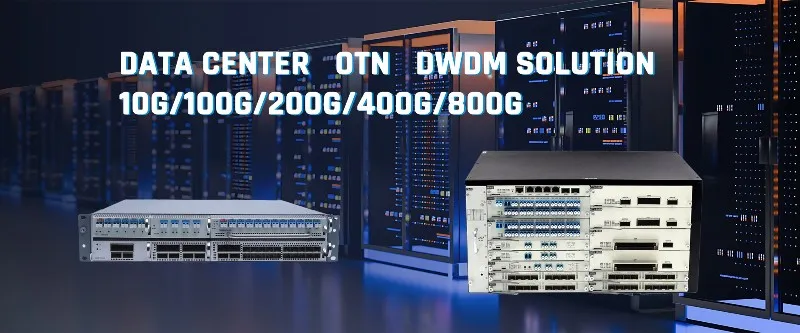
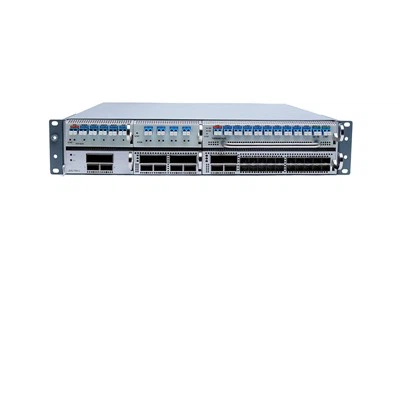
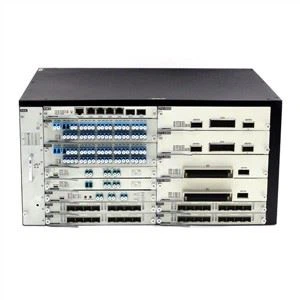
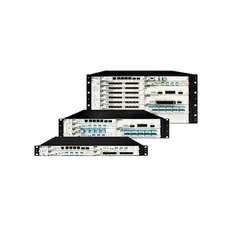
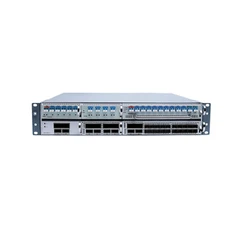
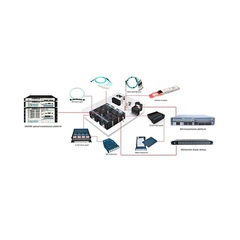
HTFuture's HT6000 5U 20-Slot Transmission Platform provides the answer. Designed for next-generation 5G and metropolitan aggregation networks, it integrates dense wavelength division multiplexing (DWDM), optical transport network (OTN) switching, and easy management into a single modular system.
Multi-Service Access for 5G and IoT
The HT6000 supports a wide range of service interfaces, including Ethernet (1G/10G/100G), CPRI/eCPRI, Fibre Channel, and SDH, allowing telecom operators to seamlessly aggregate multiple services within the same optical layer. Each channel can transmit up to 100 Gbps, and with 96 channels per chassis, the total system capacity reaches 9.6 Tbps-enough to serve entire metropolitan areas.
Low-Latency and High-Reliability Architecture
Equipped with OLP 1+1 optical protection and EDFA amplification, Its dual power supply design (AC/DC) and redundant fans further enhance system stability. For applications like smart traffic management and real-time emergency response, this level of reliability can be life-saving.
Intelligent Network Orchestration
Through the HTF EMS management system, operators gain end-to-end visibility and control. The platform enables:
Centralized fault monitoring across city layers;
Automated bandwidth provisioning;
Predictive maintenance using AI analytics;
Remote performance tuning.
These capabilities allow network administrators to maintain a real-time operational overview of complex urban networks-critical for 5G densification and smart-city deployments.
Flexible Deployment Scenarios
The HT6000 adapts to multiple network topologies:
Ring topology for metro aggregation;
Star or chain configurations for suburban connectivity;
Hybrid fiber links combining active and passive WDM solutions to overcome fiber resource limitations.
4 Real Use Cases: Smart Cities in Motion
- Across Asia, Europe, and the Middle East, the HT6000 DWDM has been deployed in numerous 5G city projects. In one metropolitan deployment, the platform enabled:
- Over 600 5G base stations interconnected within a 200 km ring;
- Network latency reduced by 37%;
- Power savings of 32% compared to traditional solutions;
- Self-healing link recovery within 80 milliseconds after fiber cuts.
- This infrastructure now supports smart transport systems, AI-driven CCTV monitoring, and intelligent street lighting-forming the backbone of a truly responsive digital city.
5 Benefits for Operators and Municipalities
The HT6000 platform delivers measurable and long-term benefits:
Higher Efficiency: Up to 40% reduction in OPEX through centralized management and energy optimization.
Future-Proof Design: Compatible with 400G coherent optics and essy for future upgrades.
Seamless Scalability: Easily expand from 8-channel to 96-channel configurations as demand grows.
Integrated Security: Optical encryption options safeguard government and financial data.
Sustainability: Lower carbon footprint supports green city initiatives and ESG targets.
Municipalities can integrate transportation, healthcare, energy, and public safety data streams through a unified transmission layer-turning fragmented systems into a cohesive digital ecosystem.
6 Empowering the Smart City Vision
A smart city is not built in a day-it is built on an intelligent infrastructure. The HT6000 enables cities to evolve from traditional, siloed networks into converged optical grids that connect every camera, sensor, and control center in real time.
Imagine a city where:
Emergency vehicles are guided through adaptive traffic lights based on live data;
Energy grids balance loads dynamically to prevent outages;
Public surveillance operates continuously with minimal latency;
IoT sensors communicate seamlessly across the urban fabric.
Behind these capabilities lies a powerful, invisible engine: a resilient optical transmission platform like the HTF HT6000.
7 Designed for a Sustainable, Connected Future
As global cities march toward 6G readiness and data-driven governance, the HT6000 remains a future-proof investment. it adaptable to emerging technologies like network slicing, edge computing, and AI-assisted orchestration.
With the HTF HT6000, telecom operators and city planners gain the tools to create smart, safe, and sustainable cities-where every bit of data contributes to a better quality of life.
8 Conclusion
The success of smart cities depends on the strength of their networks. The HTFuture HT6000 5U Transmission Platform transforms complex, multi-layered metropolitan infrastructures into agile, intelligent, and high-performance optical systems capable of supporting billions of 5G and IoT connections.
By integrating reliability, scalability, and intelligence into one cohesive platform, HTFuture empowers operators and governments to achieve the ultimate goal of digital transformation: a city that thinks, learns, and evolves.