



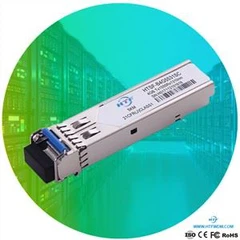


XFP is defined by the XFP Multi-Source Agreement (MSA). It was announced on July 19, 2002, officially launched on March 3, 2003, and later updated in a small range on August 31, 2005. XFP optical module is a 10G optical module that is hot-swappable and independent of the communication protocol. It can transmit data at 850nm/1310nm/1550nm wavelength. It is mainly used in 10G Ethernet, 10Gbit/s fiber channel, OC-192 Digital transmission, synchronous optical network STM-64, 10Gbit/s optical transmission network (OTN) OUT-2 and parallel optical fiber link.
SFP+ is an upgraded version of SFP, which is defined by the SFP+ Multi-Source Agreement (MSA). It was officially released on May 9, 2006, and version 4.1 was released on July 6, 2009. The SFP+ optical module is a small, hot-swappable 10G optical module that complies with IEEE 802.3ae, SFF-8431 and SFF-8432 protocols, and can work at 850nm/1310nm/1550nm wavelengths, and is used in 10G Ethernet and 10G fiber channels. , 10G SONET/SDH, OTN, CPRI wireless, 16G Fibre Channel and 32G Fibre Channel.

What is the difference between XFP and SFP+?
Size & heat dissipation: XFP optical modules are larger than SFP+ optical modules, but have better heat dissipation.
Structure: Unlike XFP, SFP+'s signal modulation function, serializer/deserializer, MAC, clock and data recovery (CDR), and electronic dispersion compensation (EDC) functions are on the motherboard instead of on the module.
Compatibility: First, it can be seen from the above that the sizes of the two are inconsistent, so the two are not compatible. Second, SFP+ ports can support SFP optical modules and SFP+ optical modules, with certain compatibility, but XFP ports can only support XFP optical modules.
Cost: 10G SFP+ optical modules have lower cost than 10G XFP optical modules, and can communicate with other types of 10G optical modules.
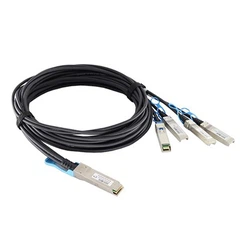
Application: For short-distance transmission of 10G optical signals, DAC high-speed cables can be used directly without optical modules. But currently there are only 10G SFP+ DAC high-speed cables on the market, and no 10G XFP DAC high-speed cables.
Popularity: It can be seen from the above that, compared to XFP, SFP+ has greater advantages in terms of size, structure, compatibility, and cost. It meets users' requirements for high density, low cost, and compatible scalability.
| Type | XFP | SFP+ |
| MSA | IEE802.3ae;XFP MSA | IEE802.3ae;SFF-8431;SFF-8432 |
| Transmission rate | 10Gbps | 6Gbps;8.5Gbps;10Gbps |
| Wavelength | 850nm/1310nm/1550nm; 1310nm/1490nm/1550nm; 1270nm-1610nm;ITU17~ITU61 | 850nm/1310nm/1550nm;1270nm/1330nm;1270nm-1610nm;ITU17~ITU61 |
| Optical fiber type | OS1/OS2/OM3/OM4 | OS1/OS2/OM3/OM4 |
| Connector | LC duplex | LC duplex |
| Distance | 220m/300m/2km/10km/20km/40km/60km/80km/120km | 300m/2km/10km/15km/20km/40km/60km/80km/100km/120km/150km |